
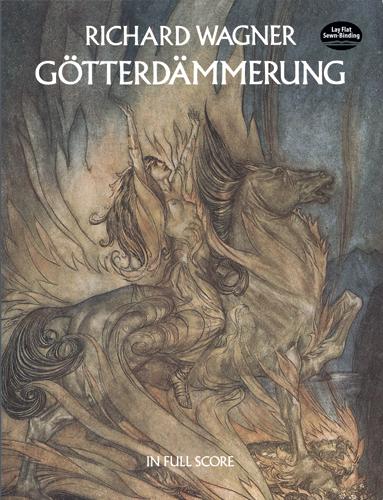
Melding literary, philosophical, and political — as well as musical — influences in his works, Richard Wagner (1813–83) brought the expressive power of German romantic opera to new heights — indeed, his music was its crowning glory. George Bernard Shaw, a critic not given to hyperbole, acknowledged Wagner's preeminent status in The Perfect Wagnerite: "He was the summit of the nineteenth-century school of dramatic music."
In Der Ring des Nibelungen, Wagner drew on a medieval German epic, the Nibelungenlied, and Norse mythology to create a new synthesis of music and drama on the largest scale. Of the four works in the Ring cycle, Götterdämmerung is perhaps the grandest and most sweeping of all. Although it is the final work in the series, the opera was actually first sketched out by Wagner in 1848, under the title Siegfrieds Tod. As it turned out, dramaturgic difficulties forced the composer to expand the tragedy of Siegfried into the four-part Ring. In 1851 he amplified Siegfrieds Tod with Der junge Siegfried (later Siegfried), and the following year wrote the texts of Die Walküre and Das Rheingold. In effect, the text of the Ring cycle was written in reverse order.
Wagner began composing the musical drafts of Götterdämmerung in 1869. Five years later, the work was complete — the capstone of an epic masterpiece that aroused near-religious fervor among its devotees. Shaw opined of the Ring as a whole: "The musical fabric is enormously elaborate and gorgeous," while Grove's Dictionary offers this comment on the special appeal of Götterdämmerung: "It is in the epic and reflective passages of Götterdämmerung, the narratives and orchestral epic of the Funeral March, that there unfurls that 'associative magic' praised so highly by Thomas Mann."
Götterdämmerung has never been available in the United States in full operatic score — until now. Reprinted directly from the rare 1877 first edition, this is the score that Wagner himself approved with the instrumentation he intended. Except for the original title page, the German-language front matter has been omitted in this edition for reasons of space and replaced by an English translation.
New admirers of Wagner, opera enthusiasts, and all music lovers can savor the full heroic impact of this majestic musical achievement in Dover's characteristically inexpensive, superbly produced edition.
Pay easily by card, Klarna, Apple Pay or Google Pay. Not happy? You always have a 14-day money-back guarantee. Read more in our terms. If you have any questions, email us at hello@memmo.org.
Memmo makes studying easier – wherever you are in the world. We bring your course books and smart study tools together in one place: summaries, quizzes, podcasts and flashcards. Plus Ted, your study buddy who answers anything you wonder. Over 50,000 students already study here – built to help you learn faster and stress less.