
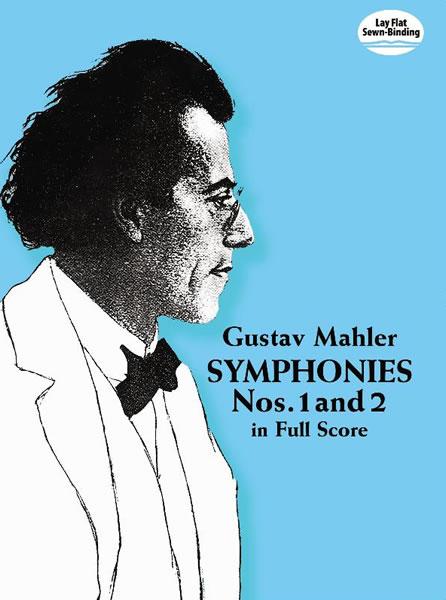
Often regarded as the last great composer in the Austro-Germanic tradition, Gustave Mahler (1860–1911) exerted a major influence on 20th-century music; his later work in particular affected the musical ideas of such composers as Arnold Schoenberg, Dimitri Shostakovich, Alban Berg, and Benjamin Britten.
While his mature work foreshadowed radical elements of modern music — particularly the dissolution of tonality — Mahler's first symphonies were written in a relatively traditional programmatic style with a strong spiritual element. These early works are seen by some critics as attempting to "establish some ultimate ground for existence in the face of pain, death, doubt, and despair." The composer's spiritual quest, as well as the vivid orchestration, innovative symphonic structure, and rich emotional expression that characterized his music can be clearly studied and appreciated in this volume, which contains complete scores of Mahler's first two symphonies.
Of the Symphony No. 1 in D Major ("Titan"), the Encyclopaedia Britannica notes, "The program of the purely orchestral Symphony No. 1 in D Major … is autobiographical of his youth; the joy of life becomes clouded over by an obsession with death in the macabre "Funeral March in the Manner of Callot (basically a parody of popular music), which is eventually routed in the arduous and brilliant finale."
Of Symphony No. 1 in C Minor, ("Resurrection"), Grove's Dictionary of Music and Musicians states: "Symphony II is a good example of all Mahler's works … scored nearly always heavily for a large orchestra, restless and stormy in places, monumentally exalted in others."
Now both works are available in this handsome, inexpensive edition, reproduced directly from the original editions published by Josef Weinberger in Vienna in 1897 and 1899. Beautifully printed with wide margins and clear noteheads, this edition of the symphonies offers an unparalleled resource for studying and enjoying the seminal works of a modern master.
Pay easily by card, Klarna, Apple Pay or Google Pay. Not happy? You always have a 14-day money-back guarantee. Read more in our terms. If you have any questions, email us at hello@memmo.org.
Memmo makes studying easier – wherever you are in the world. We bring your course books and smart study tools together in one place: summaries, quizzes, podcasts and flashcards. Plus Ted, your study buddy who answers anything you wonder. Over 50,000 students already study here – built to help you learn faster and stress less.