
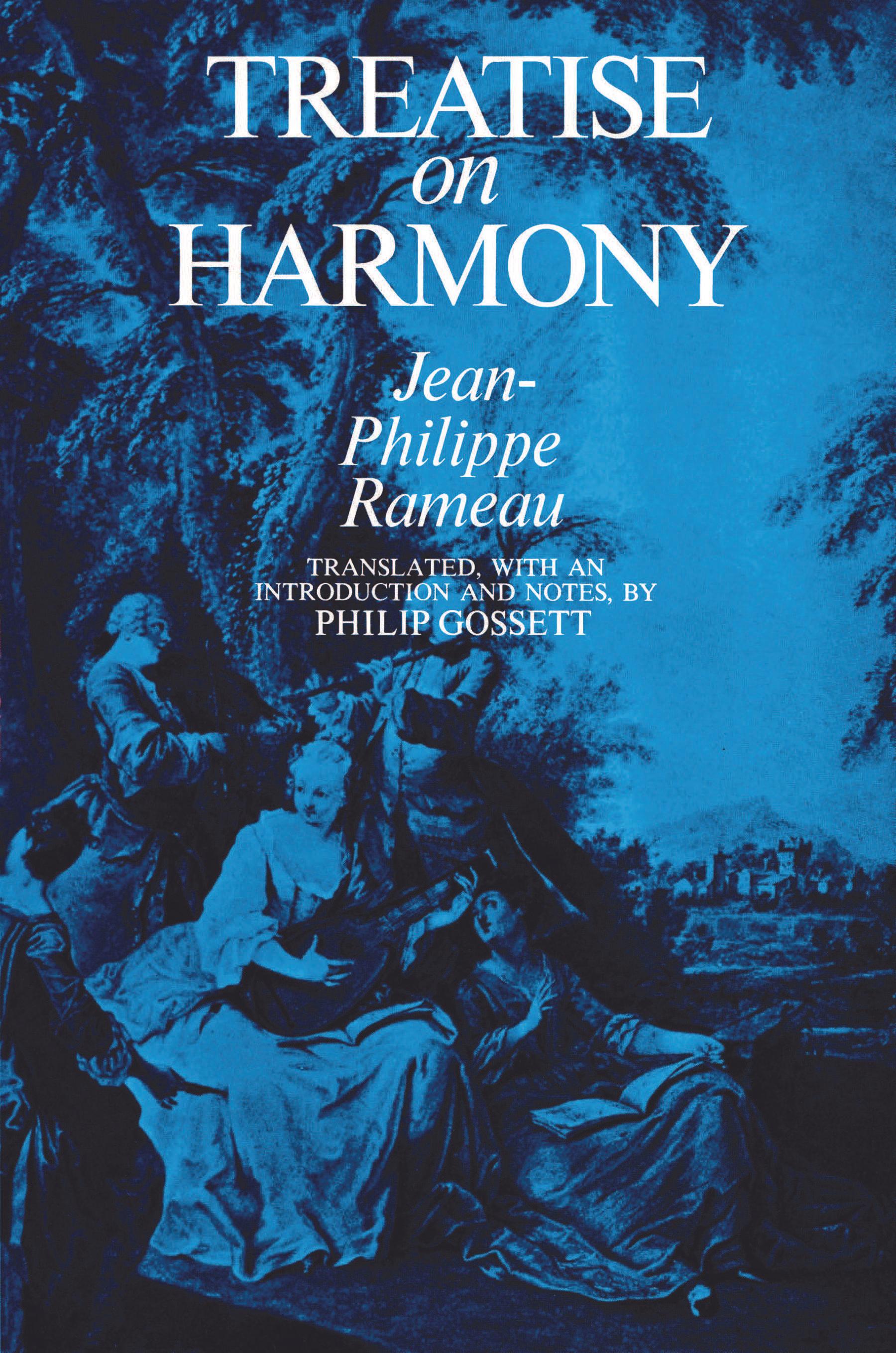
The Traité de l'harmonie of Jen-Philippe Rameau is one of the most important books in the history of Western music. Written while Rameau was still a relatively obscure organist and music master at Clermont-Ferrand, the book received but one printing during Rameau's life, in 1722, shortly before he settled in Paris. The Traité was immediately recognized as a profound advance in musical theory, however, and it established Rameau's reputation as a theorist. His book was the first to codify those principles of tonality that were to dominate the music of the West for almost two centuries. Even today the theories of Rameau remain the basis for the study of harmony.
Rameau's Traité de l'harmonie is divided into four books, the first of which presents the mathematical basis from which Rameau sought to derive his theories. Book Two may be considered the most important section of the Traité; in it Rameau generates his entire harmonic system from fundamental principles, explaining intervals, chords, and modes — everything, in fact, essential to musical composition in tonal style. Working from the principles developed in Books One and Two, Book Three treats the practical rules of composition, including such topics as harmonic modulation and chord progressions. Book Four concerns the practical art of accompaniment on harpsichord or organ, including the realization of a figured bass. Corrections added by Rameau in a supplement are included in the text, and all the musical examples have been reset in modern musical notation. In addition, two pages from a unique copy of the first issue of the first edition are given in facsimile. The translator's introduction discusses the history of the work, Rameau's mathematics, and his place in the history of music theory.
Pay easily by card, Klarna, Apple Pay or Google Pay. Not happy? You always have a 14-day money-back guarantee. Read more in our terms. If you have any questions, email us at hello@memmo.org.
Memmo makes studying easier – wherever you are in the world. We bring your course books and smart study tools together in one place: summaries, quizzes, podcasts and flashcards. Plus Ted, your study buddy who answers anything you wonder. Over 50,000 students already study here – built to help you learn faster and stress less.