
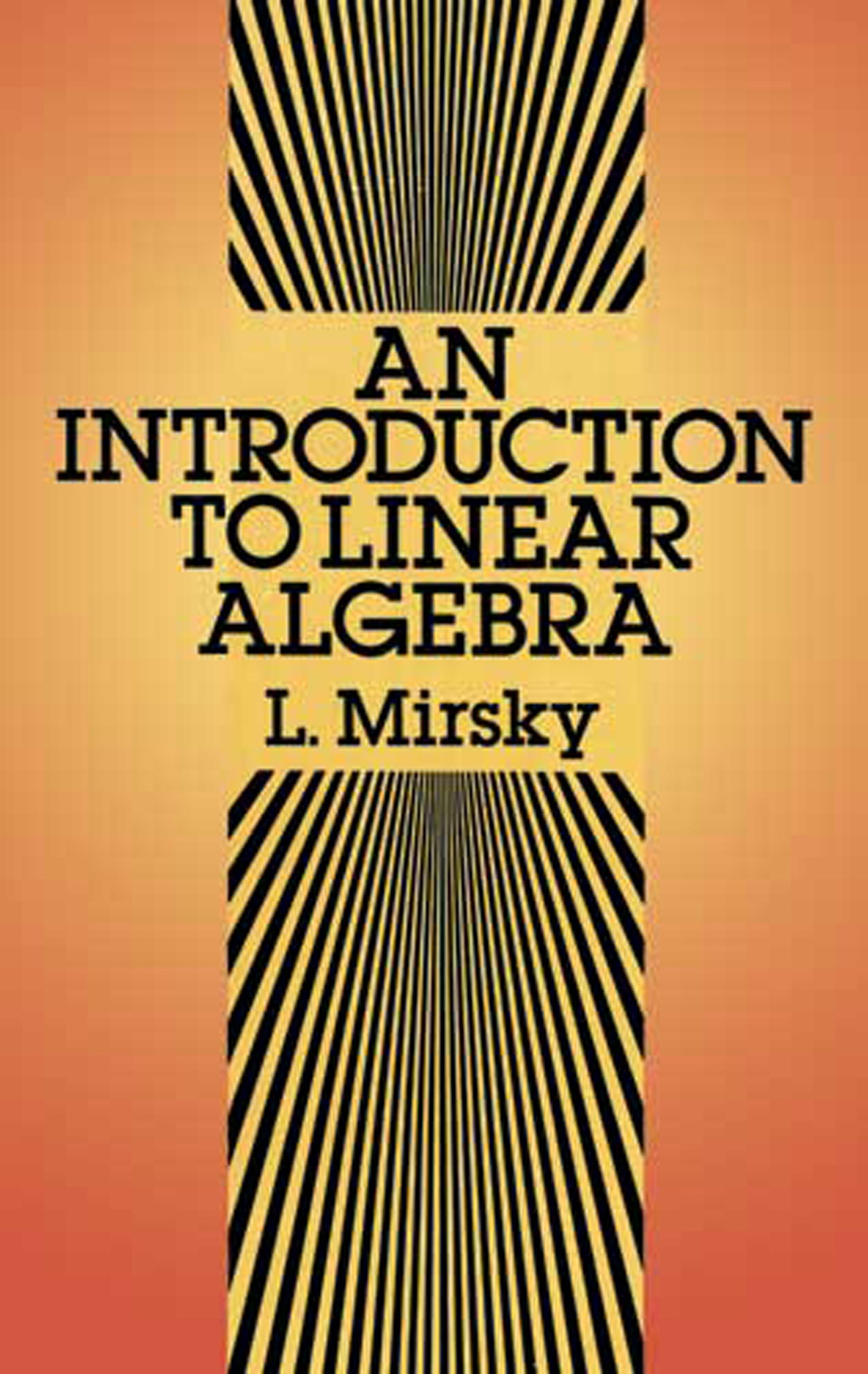
"The straight-forward clarity of the writing is admirable." — American Mathematical Monthly.
This work provides an elementary and easily readable account of linear algebra, in which the exposition is sufficiently simple to make it equally useful to readers whose principal interests lie in the fields of physics or technology. The account is self-contained, and the reader is not assumed to have any previous knowledge of linear algebra. Although its accessibility makes it suitable for non-mathematicians, Professor Mirsky's book is nevertheless a systematic and rigorous development of the subject.
Part I deals with determinants, vector spaces, matrices, linear equations, and the representation of linear operators by matrices. Part II begins with the introduction of the characteristic equation and goes on to discuss unitary matrices, linear groups, functions of matrices, and diagonal and triangular canonical forms. Part II is concerned with quadratic forms and related concepts. Applications to geometry are stressed throughout; and such topics as rotation, reduction of quadrics to principal axes, and classification of quadrics are treated in some detail. An account of most of the elementary inequalities arising in the theory of matrices is also included. Among the most valuable features of the book are the numerous examples and problems at the end of each chapter, carefully selected to clarify points made in the text.
This work provides an elementary and easily readable account of linear algebra, in which the exposition is sufficiently simple to make it equally useful to readers whose principal interests lie in the fields of physics or technology. The account is self-contained, and the reader is not assumed to have any previous knowledge of linear algebra. Although its accessibility makes it suitable for non-mathematicians, Professor Mirsky's book is nevertheless a systematic and rigorous development of the subject.
Part I deals with determinants, vector spaces, matrices, linear equations, and the representation of linear operators by matrices. Part II begins with the introduction of the characteristic equation and goes on to discuss unitary matrices, linear groups, functions of matrices, and diagonal and triangular canonical forms. Part II is concerned with quadratic forms and related concepts. Applications to geometry are stressed throughout; and such topics as rotation, reduction of quadrics to principal axes, and classification of quadrics are treated in some detail. An account of most of the elementary inequalities arising in the theory of matrices is also included. Among the most valuable features of the book are the numerous examples and problems at the end of each chapter, carefully selected to clarify points made in the text.
Pay easily by card, Klarna, Apple Pay or Google Pay. Not happy? You always have a 14-day money-back guarantee. Read more in our terms. If you have any questions, email us at hello@memmo.org.
Memmo makes studying easier – wherever you are in the world. We bring your course books and smart study tools together in one place: summaries, quizzes, podcasts and flashcards. Plus Ted, your study buddy who answers anything you wonder. Over 75,000 students already study here – built to help you learn faster and stress less.
You might also like
Buy the book0