
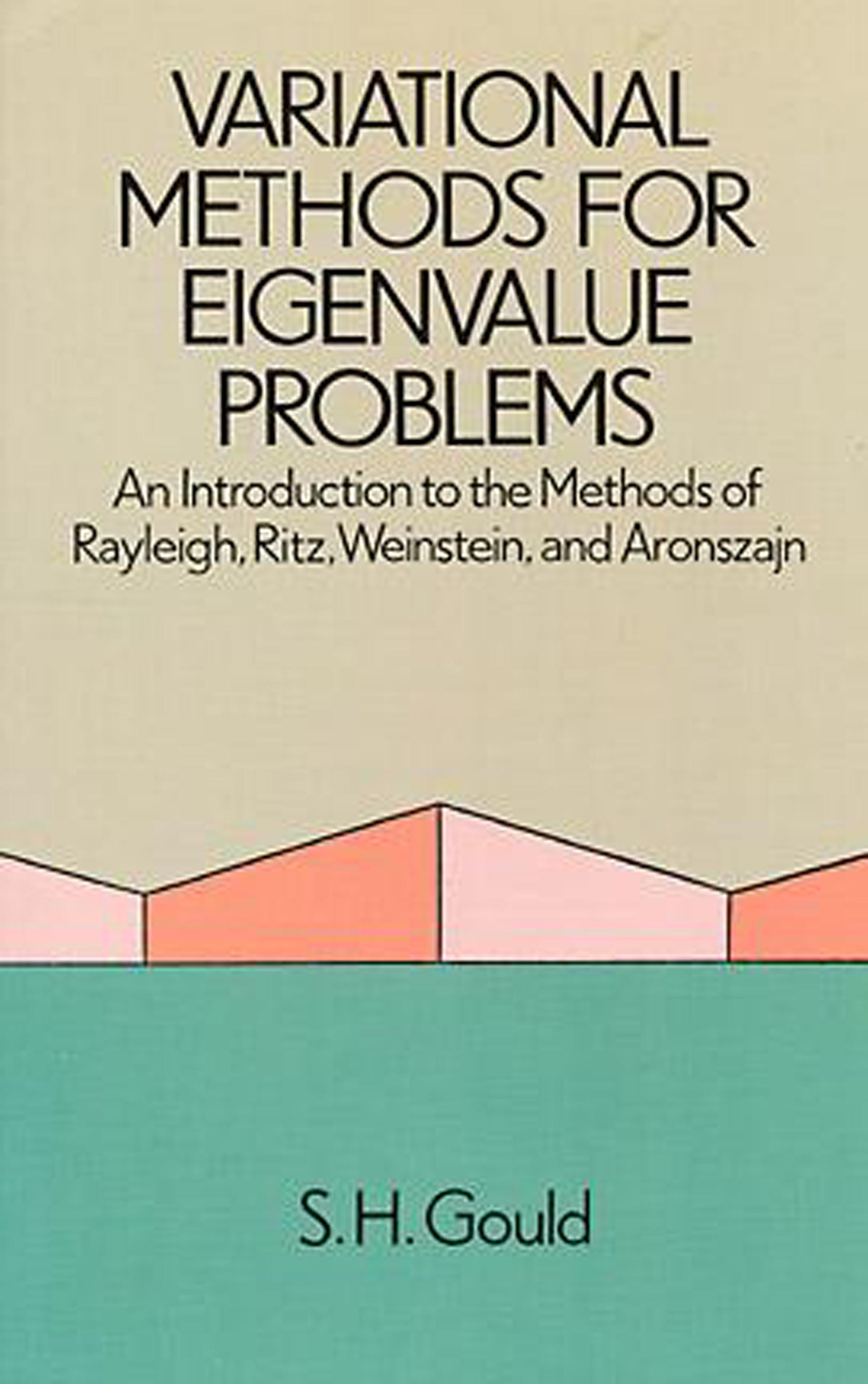
The importance of eigenvalue theory in pure and applied mathematics, and in physics and chemistry, makes it incumbent on students to understand the various methods of approximate calculation of eigenvalues. It is especially important to develop such methods in a general and theoretical manner, if only to avoid missing opportunities for particular applications. This book does just that, approaching the topic from a purely mathematical standpoint.
Because variational methods are particularly well adapted to successive approximation, this book gives a simple exposition of such methods, not only of the familiar Rayleigh-Ritz method, but especially of the related methods — the Weinstein method, Weinstein-Aronszajn method, and others.
To make the book accessible to a broad range of students, little mathematical knowledge is presupposed beyond the elements of calculus. Where specialized knowledge is required — as it is in the discussion of direct methods in the calculus of variations and the theory of completely continuous operators in Hilbert space — the requisite material is developed in full.
The first nine chapters, written in elementary style, discuss the general theory of variational methods with special reference to the vibrating plate. In the last chapter, the information gained thereby is extended, in a less elementary way, to more general cases. Exercises are provided throughout to illuminate the ideas and methods developed in the text.
Because variational methods are particularly well adapted to successive approximation, this book gives a simple exposition of such methods, not only of the familiar Rayleigh-Ritz method, but especially of the related methods — the Weinstein method, Weinstein-Aronszajn method, and others.
To make the book accessible to a broad range of students, little mathematical knowledge is presupposed beyond the elements of calculus. Where specialized knowledge is required — as it is in the discussion of direct methods in the calculus of variations and the theory of completely continuous operators in Hilbert space — the requisite material is developed in full.
The first nine chapters, written in elementary style, discuss the general theory of variational methods with special reference to the vibrating plate. In the last chapter, the information gained thereby is extended, in a less elementary way, to more general cases. Exercises are provided throughout to illuminate the ideas and methods developed in the text.
Pay easily by card, Klarna, Apple Pay or Google Pay. Not happy? You always have a 14-day money-back guarantee. Read more in our terms. If you have any questions, email us at hello@memmo.org.
Memmo makes studying easier – wherever you are in the world. We bring your course books and smart study tools together in one place: summaries, quizzes, podcasts and flashcards. Plus Ted, your study buddy who answers anything you wonder. Over 75,000 students already study here – built to help you learn faster and stress less.
You might also like
Buy the book0