
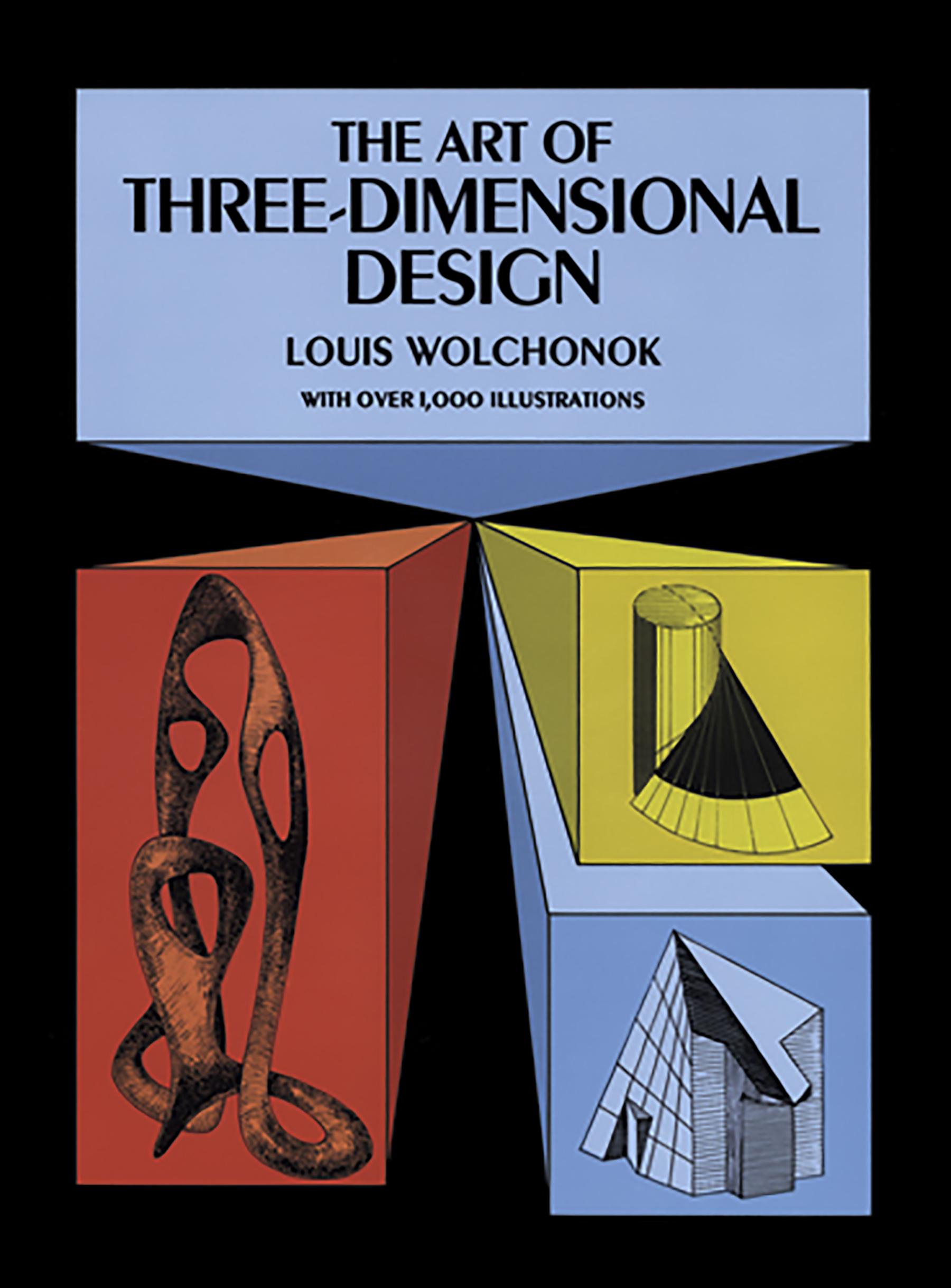
Prepared by a nationally known teacher of art and design, this guide to the creation of space figures in design points out the countless possibilities inherent in the basic geometric surfaces and solids. It demonstrates how they can be transformed into three-dimensional design motifs, and it encourages the reader's imagination to envision in the round the space figures he draws and sketches as rough notations. It also shows how to reduce natural and man-made forms to their geometric equivalents and, by new combinations, create original three-dimensional products.
Mr. Wolchonok approaches his subject through an investigation of the properties of the various geometric surfaces — plane, prismatic, cylindric, pyramidal, conical, spherical, ribbon and sheet surfaces and surfaces of revolution — and demonstrates ably how each of these can be modified, adapted, and transformed into many new forms. He shows how designs can be constructed from combinations of surfaces — for example, how intersections between cylinders, prisms and pyramids can be used in designing such objects as candelabras, receptacles, or table legs. He discusses repetition of motif and the rhythmic flow of surfaces; he describes and illustrates more than two hundred variations of human and animal forms that can be constructed in stone, clay, silver, brass, copper, or wood with combinations of three-dimensional geometric forms.
This book will be a source of constant reference for interior designers, sculptors, ceramists, silversmiths, product designers, architects, display craftsmen, furniture designers, and all those whose hobbies or professions make use of three-dimensional design.
Mr. Wolchonok approaches his subject through an investigation of the properties of the various geometric surfaces — plane, prismatic, cylindric, pyramidal, conical, spherical, ribbon and sheet surfaces and surfaces of revolution — and demonstrates ably how each of these can be modified, adapted, and transformed into many new forms. He shows how designs can be constructed from combinations of surfaces — for example, how intersections between cylinders, prisms and pyramids can be used in designing such objects as candelabras, receptacles, or table legs. He discusses repetition of motif and the rhythmic flow of surfaces; he describes and illustrates more than two hundred variations of human and animal forms that can be constructed in stone, clay, silver, brass, copper, or wood with combinations of three-dimensional geometric forms.
This book will be a source of constant reference for interior designers, sculptors, ceramists, silversmiths, product designers, architects, display craftsmen, furniture designers, and all those whose hobbies or professions make use of three-dimensional design.
Pages: 169
Category: Konst, Design & Fotografi
e-ISBN: 9780486157214
Shipping weight: 1.2 kg
Ships in: 1-2 days
Pay easily by card, Klarna, Apple Pay or Google Pay. Not happy? You always have a 14-day money-back guarantee. Read more in our terms. If you have any questions, email us at hello@memmo.org.
Memmo makes studying easier – wherever you are in the world. We bring your course books and smart study tools together in one place: summaries, quizzes, podcasts and flashcards. Plus Ted, your study buddy who answers anything you wonder. Over 50,000 students already study here – built to help you learn faster and stress less.
You might also like
Buy the book0