
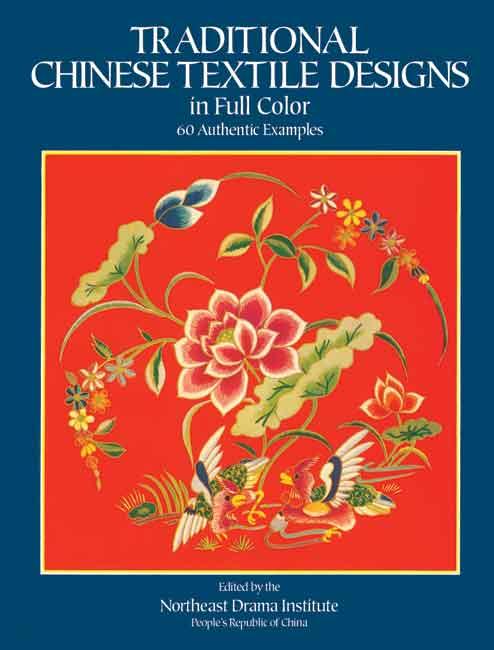
Traditional Chinese opera is highly stylized in structure, music, subject matter, and staging. Movements and gestures follow age-old patterns, and the physical appearance of the performers is rigidly controlled, especially their costumes, which reveal social rank, occupation, and often personality traits of the characters. Traditional, well-known motifs are embroidered in colored silk or cotton on specifically prescribed parts of the costume to act as symbols or emblems. Since the motifs are crucial to such symbolic representations, they are the focus of the greatest possible care and art.
This handsome volume reproduces 60 authentic full-color motifs, originally published in mainland China. Beautifully painted by Lu Hua and Ma Chiang, the motifs include dragons, lions, phoenixes, sharks, cranes, lotuses, peonies, plum blossoms, and more. Incorporated in these designs are timeless themes found throughout Chinese art: a permeating sense of nature depicted with a sense of growing, moving life; the perfection of shape and proportion that defines a godlike universality. In their subtle coloring, harmonious interplay of shape and form, and interlocking symmetrical designs, these motifs perpetuate ancient traditions of symbolic representation and allegorical meaning.
Produced with meticulous care and taste, this album of motifs displays each design at its best: details are sharp and clear against monochromatic backgrounds; subtle hues with stylized renderings of birds, fish, animals, flowers, clouds, waves, and other shapes achieve a highly controlled composition of unity and grace. Designs are also ingeniously adapted to their specific use on the garment: as circular "crests" for broad flat areas, and as elongated panels for borders, collars, and trouser legs. Captions identify each motif and briefly indicate the type of costume, and the parts of the costume on which they occur.
Pay easily by card, Klarna, Apple Pay or Google Pay. Not happy? You always have a 14-day money-back guarantee. Read more in our terms. If you have any questions, email us at hello@memmo.org.
Memmo makes studying easier – wherever you are in the world. We bring your course books and smart study tools together in one place: summaries, quizzes, podcasts and flashcards. Plus Ted, your study buddy who answers anything you wonder. Over 50,000 students already study here – built to help you learn faster and stress less.