
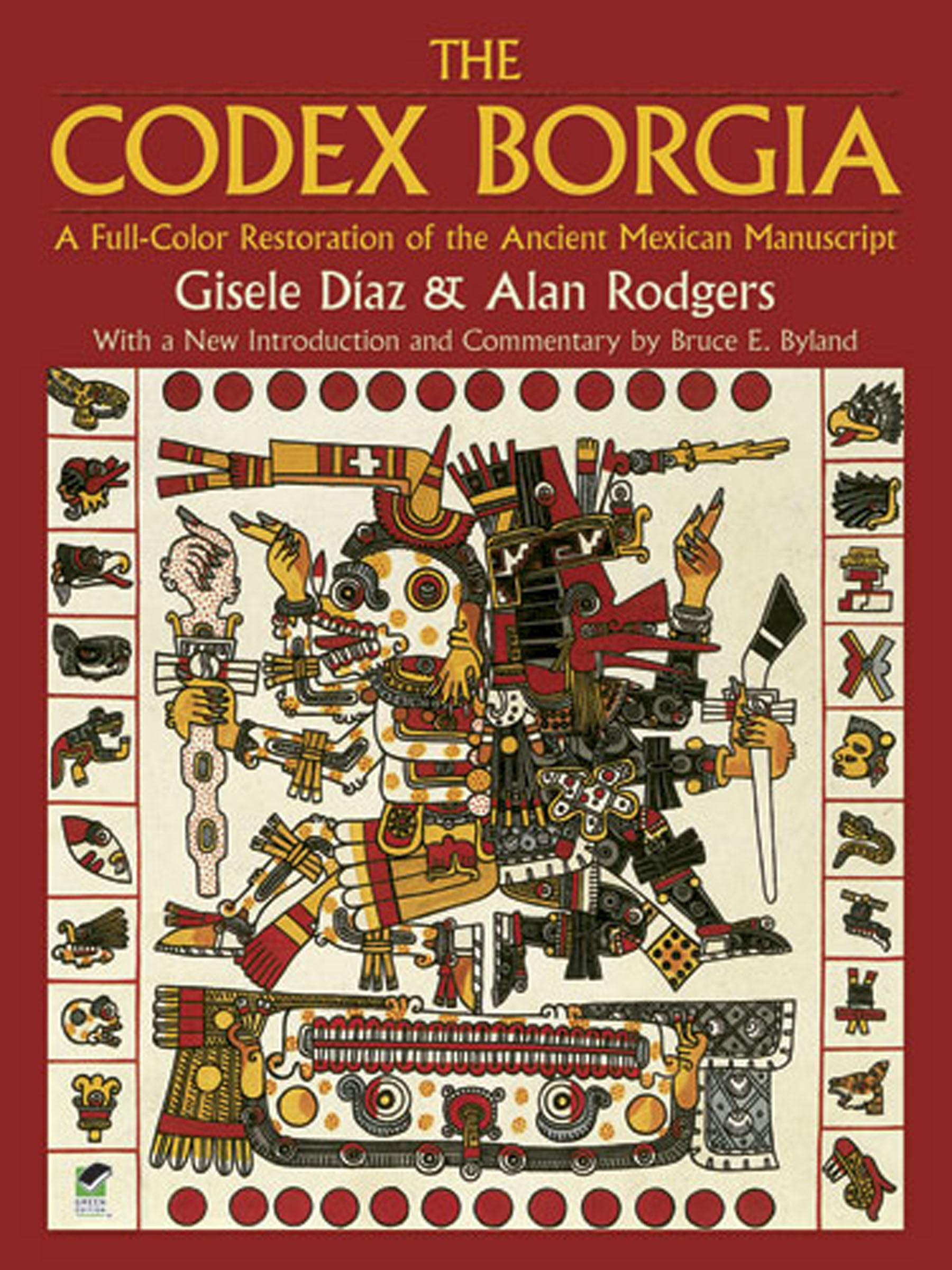
Considered by many scholars the finest extant Mexican codex and one of the most important original sources for the study of pre-Columbian religion, the Codex Borgia is a work of profound beauty, filled with strange and evocative images related to calendrical, cosmological, ritual, and divinatory matters. Generally similar to such Mixtec manuscripts as the Codex Nuttall, the Codex Borgia is thought to have its origin (ca. A.D. 1400) in the southern central highlands of Mexico, perhaps in Puebla or Oaxaca. It is most probably a religious document that once belonged to a temple or sacred shrine.
One use of the Codex many have been to divine the future, for it includes ritual 260 day calendars, material on aspects of the planet Venus, and a sort of numerological prognostic of the lives of wedded couples. Another section concerns various regions of the world and the supernatural characters and attributes of those regions. Also described are the characteristics of a number of deities, while still other passages relate to installation ceremonies of rulers in pre-Columbian kingdoms.
Until the publication of this Dover edition, the Codex Borgia has been largely inaccessible to the general public. The priceless original is in the Vatican Library and previous photographic facsimiles are very rare or very expensive or both. Moreover, the original Codex has been damaged over the centuries, resulting in the obscuration and loss of many images. In order to recapture the beauty and grandeur of the original, Gisele Diaz and Alan Rodgers have painstakingly restored the Codex by hand— a seven-year project — employing the most scrupulous research and restoration techniques. The result is 76 large full-color plates of vibrant, striking depictions of gods, kings, warriors, mythical creatures, and mysterious abstract designs — a vivid panorama that offers profound insights into pre-Columbian Mexican myth and ritual. Now students, anthropologists, lovers of fine art and rare books — anyone interested in the art and culture of ancient Mexico — can study the Codex Borgia in this inexpensive, accurate, well-made edition. An informative introduction by noted anthropologist Bruce E. Byland places the Codex in its historical context and helps elucidate its meaning and significance.
Pay easily by card, Klarna, Apple Pay or Google Pay. Not happy? You always have a 14-day money-back guarantee. Read more in our terms. If you have any questions, email us at hello@memmo.org.
Memmo makes studying easier – wherever you are in the world. We bring your course books and smart study tools together in one place: summaries, quizzes, podcasts and flashcards. Plus Ted, your study buddy who answers anything you wonder. Over 75,000 students already study here – built to help you learn faster and stress less.