
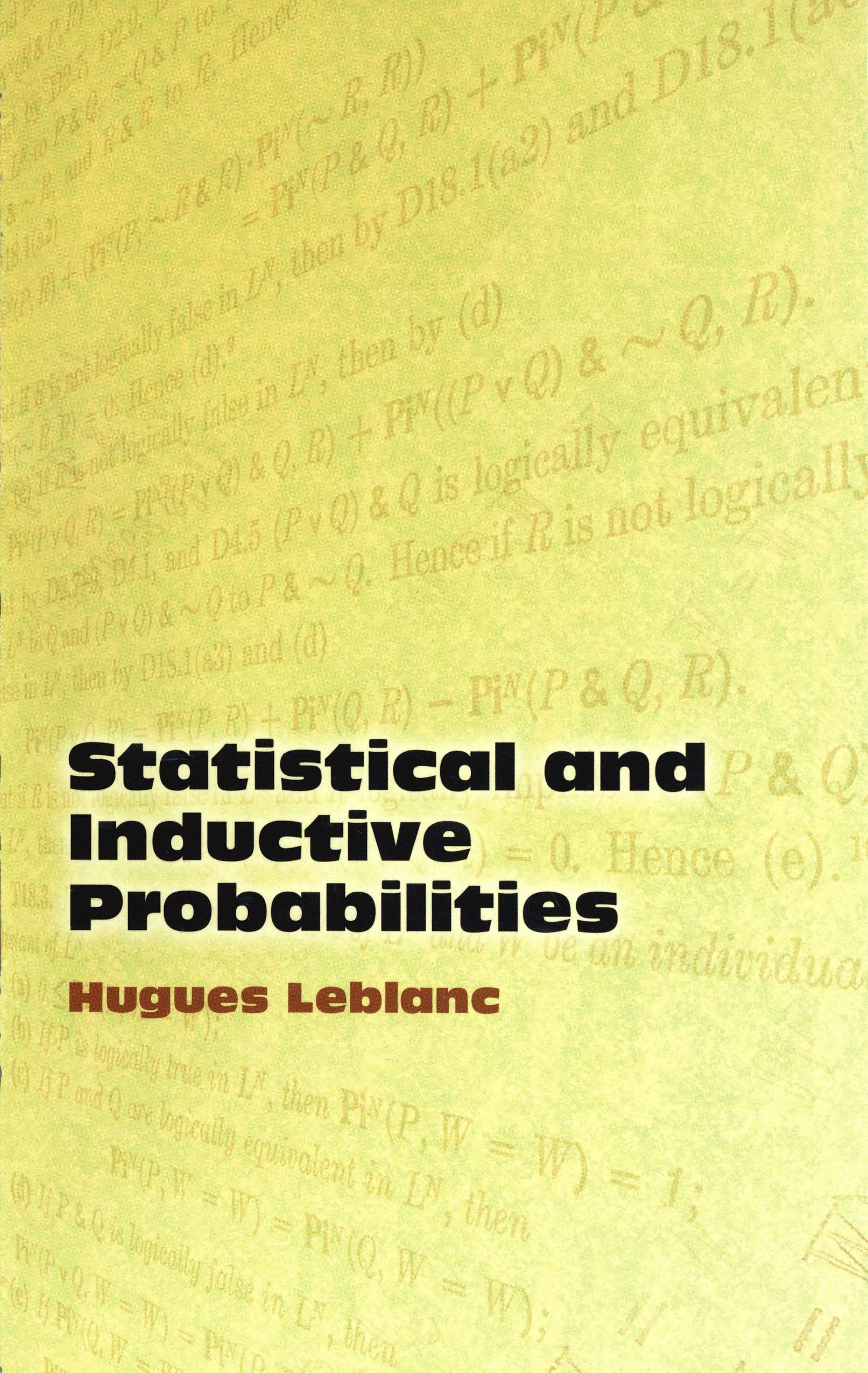
Among probability theorists, a bitter controversy has raged for decades between the adherents of John Maynard Keynes' A Treatise on Probability (1921) and those of Richard von Mises' "Grundlagen der Wahrscheinlichkeitsrechnung" (1919). Keynes declared that probabilities measure the extent to which a so-called evidence proposition supports another sentence. Von Mises insisted that they measure the relative frequency with which the members of a so-called reference set belong to another set. Statistical and Inductive Probabilities offers an evenhanded treatment of this issue, asserting that both statistical and inductive probabilities may be treated as sentence-theoretic measurements, and that the latter qualify as estimates of the former.
Beginning with a survey of the essentials of sentence theory and of set theory, author Hugues Leblanc examines statistical probabilities (which are allotted to sets by von Mises' followers), showing that statistical probabilities may be passed on to sentences, and thereby qualify as truth-values. Leblanc concludes with an exploration of inductive probabilities (which Keynes' followers allot to sentences), demonstrating their reinterpretation as estimates of truth-values.
Each chapter is preceded by a summary of its contents. Illustrations accompany most definitions and theorems, and footnotes elucidate technicalities and bibliographical references.
Beginning with a survey of the essentials of sentence theory and of set theory, author Hugues Leblanc examines statistical probabilities (which are allotted to sets by von Mises' followers), showing that statistical probabilities may be passed on to sentences, and thereby qualify as truth-values. Leblanc concludes with an exploration of inductive probabilities (which Keynes' followers allot to sentences), demonstrating their reinterpretation as estimates of truth-values.
Each chapter is preceded by a summary of its contents. Illustrations accompany most definitions and theorems, and footnotes elucidate technicalities and bibliographical references.
Pages: 160
Category: Vetenskapsteori och forskningsmetod
e-ISBN: 9780486154824
Shipping weight: 1.2 kg
Ships in: 1-2 days
Pay easily by card, Klarna, Apple Pay or Google Pay. Not happy? You always have a 14-day money-back guarantee. Read more in our terms. If you have any questions, email us at hello@memmo.org.
Memmo makes studying easier – wherever you are in the world. We bring your course books and smart study tools together in one place: summaries, quizzes, podcasts and flashcards. Plus Ted, your study buddy who answers anything you wonder. Over 50,000 students already study here – built to help you learn faster and stress less.
You might also like
Buy the book0