
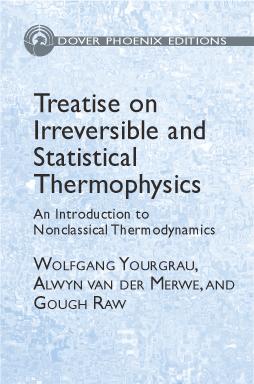
“Thermophysics poses one of the most exciting questions in theoretical physics: how can one reconcile the irreversibility of natural processes with the reversible mechanics governing the elementary constituents of thermal systems?” Professors Yourgrau, van der Merwe, and Raw prefaced their treatise with this remark more than 30 years ago; while progress in thermophysics has been, to say the least, dynamic, the remark and the excitement hold true today.
For this Dover edition, the authors (including Wolfgang Yourgrau before his death) extensively revised the treatise. The terms are the same: thermophysics “examines the connection of temperature and entropy with the nonthermal properties of matter and radiation.” Thermodynamics strictly refers to “the phenomenological part of thermophysics,” generally nonequilibrious; systems in thermomechanical equilibrium belong to thermostatics. Thermophysics conveniently divides into phenomenological (microscopic properties) and statistical (atomic). Classical thermophysics, finally, “excludes the whole of statistical mechanics, while in the phenomenological domain it includes only thermostatics.”
Contents include:
Thermodynamics of Irreversible Processes
General Principles of Statistical Thermodynamics
Assemblies of Noninteracting Structureless Particles
Statistical Theory and More Complex Physical Systems
Each chapter has a bibliography; problems related to specific chapters are offered at the end of the work (no solutions). The reappearance of this treatise in a handsomely bound format will be especially welcomed by advanced students of physics; professors and specialized researchers will want this lucid monograph in their personal libraries for reference and review.
For this Dover edition, the authors (including Wolfgang Yourgrau before his death) extensively revised the treatise. The terms are the same: thermophysics “examines the connection of temperature and entropy with the nonthermal properties of matter and radiation.” Thermodynamics strictly refers to “the phenomenological part of thermophysics,” generally nonequilibrious; systems in thermomechanical equilibrium belong to thermostatics. Thermophysics conveniently divides into phenomenological (microscopic properties) and statistical (atomic). Classical thermophysics, finally, “excludes the whole of statistical mechanics, while in the phenomenological domain it includes only thermostatics.”
Contents include:
Thermodynamics of Irreversible Processes
General Principles of Statistical Thermodynamics
Assemblies of Noninteracting Structureless Particles
Statistical Theory and More Complex Physical Systems
Each chapter has a bibliography; problems related to specific chapters are offered at the end of the work (no solutions). The reappearance of this treatise in a handsomely bound format will be especially welcomed by advanced students of physics; professors and specialized researchers will want this lucid monograph in their personal libraries for reference and review.
Pay easily by card, Klarna, Apple Pay or Google Pay. Not happy? You always have a 14-day money-back guarantee. Read more in our terms. If you have any questions, email us at hello@memmo.org.
Memmo makes studying easier – wherever you are in the world. We bring your course books and smart study tools together in one place: summaries, quizzes, podcasts and flashcards. Plus Ted, your study buddy who answers anything you wonder. Over 50,000 students already study here – built to help you learn faster and stress less.
You might also like
Buy the book0