
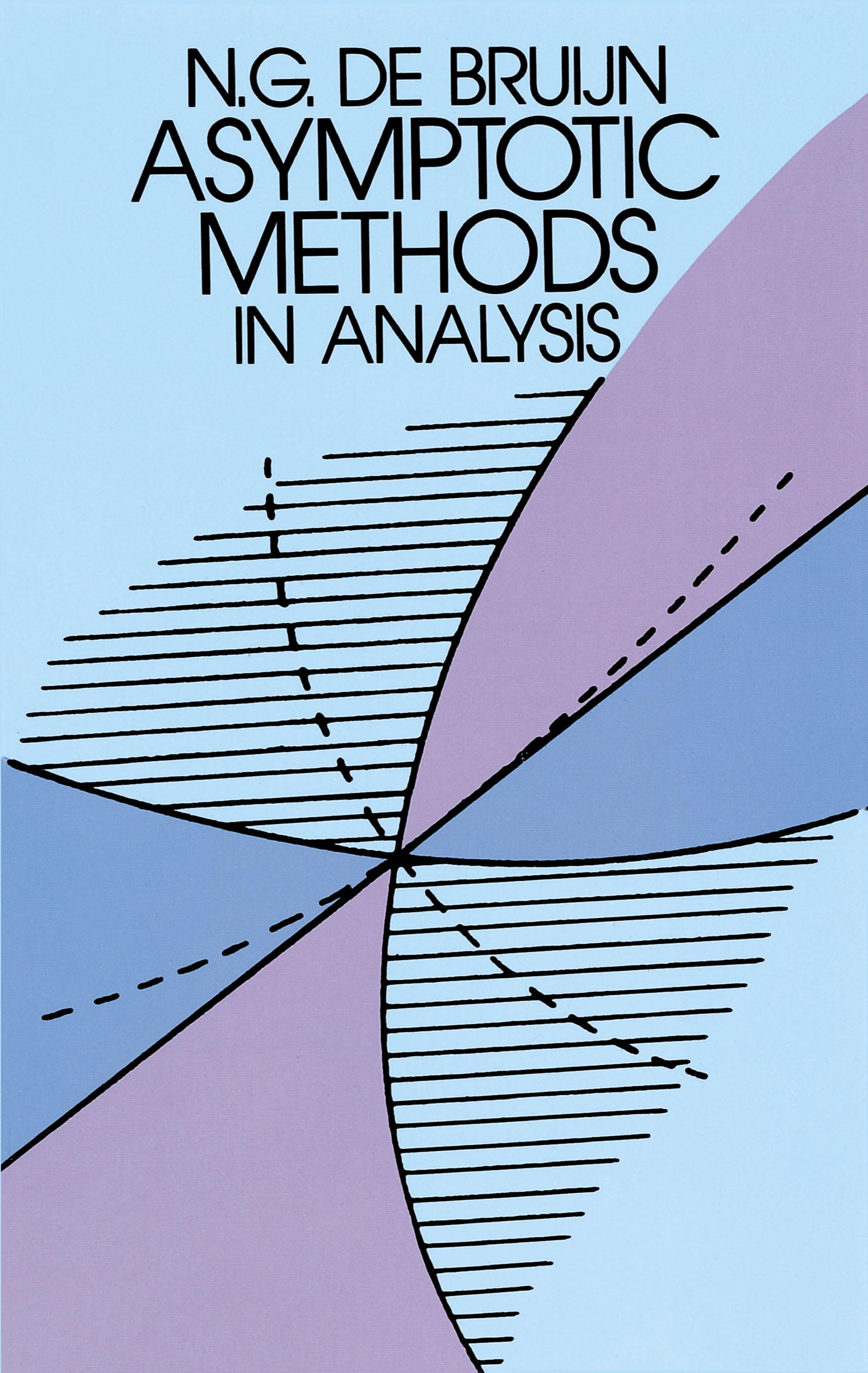
"A reader looking for interesting problems tackled often by highly original methods, for precise results fully proved, and for procedures fully motivated, will be delighted." — Mathematical Reviews.
Asymptotics is not new. Its importance in many areas of pure and applied mathematics has been recognized since the days of Laplace. Asymptotic estimates of series, integrals, and other expressions are commonly needed in physics, engineering, and other fields. Unfortunately, for many years there was a dearth of literature dealing with this difficult but important topic. Then, in 1958, Professor N. G. de Bruijn published this pioneering study. Widely considered the first text on the subject — and the first comprehensive coverage of this broad field — the book embodied an original and highly effective approach to teaching asymptotics. Rather than trying to formulate a general theory (which, in the author's words, "leads to stating more and more about less and less") de Bruijn teaches asymptotic methods through a rigorous process of explaining worked examples in detail.
Most of the important asymptotic methods are covered here with unusual effectiveness and clarity: "Every step in the mathematical process is explained, its purpose and necessity made clear, with the result that the reader not only has no difficulty in following the rigorous proofs, but even turns to them with eager expectation." (Nuclear Physics).
Part of the attraction of this book is its pleasant, straightforward style of exposition, leavened with a touch of humor and occasionally even using the dramatic form of dialogue. The book begins with a general introduction (fundamental to the whole book) on O and o notation and asymptotic series in general. Subsequent chapters cover estimation of implicit functions and the roots of equations; various methods of estimating sums; extensive treatment of the saddle-point method with full details and intricate worked examples; a brief introduction to Tauberian theorems; a detailed chapter on iteration; and a short chapter on asymptotic behavior of solutions of differential equations. Most chapters progress from simple examples to difficult problems; and in some cases, two or more different treatments of the same problem are given to enable the reader to compare different methods. Several proofs of the Stirling theorem are included, for example, and the problem of the iterated sine is treated twice in Chapter 8. Exercises are given at the end of each chapter.
Since its first publication, Asymptotic Methods in Analysis has received widespread acclaim for its rigorous and original approach to teaching a difficult subject. This Dover edition, with corrections by the author, offers students, mathematicians, engineers, and physicists not only an inexpensive, comprehensive guide to asymptotic methods but also an unusually lucid and useful account of a significant mathematical discipline.
Asymptotics is not new. Its importance in many areas of pure and applied mathematics has been recognized since the days of Laplace. Asymptotic estimates of series, integrals, and other expressions are commonly needed in physics, engineering, and other fields. Unfortunately, for many years there was a dearth of literature dealing with this difficult but important topic. Then, in 1958, Professor N. G. de Bruijn published this pioneering study. Widely considered the first text on the subject — and the first comprehensive coverage of this broad field — the book embodied an original and highly effective approach to teaching asymptotics. Rather than trying to formulate a general theory (which, in the author's words, "leads to stating more and more about less and less") de Bruijn teaches asymptotic methods through a rigorous process of explaining worked examples in detail.
Most of the important asymptotic methods are covered here with unusual effectiveness and clarity: "Every step in the mathematical process is explained, its purpose and necessity made clear, with the result that the reader not only has no difficulty in following the rigorous proofs, but even turns to them with eager expectation." (Nuclear Physics).
Part of the attraction of this book is its pleasant, straightforward style of exposition, leavened with a touch of humor and occasionally even using the dramatic form of dialogue. The book begins with a general introduction (fundamental to the whole book) on O and o notation and asymptotic series in general. Subsequent chapters cover estimation of implicit functions and the roots of equations; various methods of estimating sums; extensive treatment of the saddle-point method with full details and intricate worked examples; a brief introduction to Tauberian theorems; a detailed chapter on iteration; and a short chapter on asymptotic behavior of solutions of differential equations. Most chapters progress from simple examples to difficult problems; and in some cases, two or more different treatments of the same problem are given to enable the reader to compare different methods. Several proofs of the Stirling theorem are included, for example, and the problem of the iterated sine is treated twice in Chapter 8. Exercises are given at the end of each chapter.
Since its first publication, Asymptotic Methods in Analysis has received widespread acclaim for its rigorous and original approach to teaching a difficult subject. This Dover edition, with corrections by the author, offers students, mathematicians, engineers, and physicists not only an inexpensive, comprehensive guide to asymptotic methods but also an unusually lucid and useful account of a significant mathematical discipline.
Pay easily by card, Klarna, Apple Pay or Google Pay. Not happy? You always have a 14-day money-back guarantee. Read more in our terms. If you have any questions, email us at hello@memmo.org.
Memmo makes studying easier – wherever you are in the world. We bring your course books and smart study tools together in one place: summaries, quizzes, podcasts and flashcards. Plus Ted, your study buddy who answers anything you wonder. Over 75,000 students already study here – built to help you learn faster and stress less.
You might also like
Buy the book0