
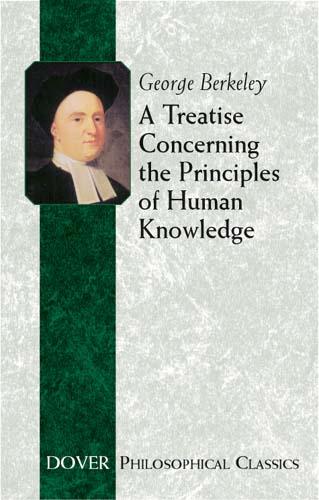
If a tree falls in the forest and no one is present to hear it, does it make a sound? It does not, according to George Berkeley. Originally published in 1710, this landmark of Western philosophy introduced a revolutionary concept: immaterialism, which asserts that to be is to perceive or be perceived.
An Irish clergyman who spent his entire philosophical career as a churchman, Berkeley linked his investigations to his religious interests. A Treatise Concerning the Principles of Human Knowledge opens with an assault on Locke’s theory of abstract ideas and proceeds with arguments that sensible qualities exist only when perceived as ideas. Physical objects, he claims, are no more than collections of qualities, and these sensible objects, too, are merely ideas. Berkeley relates his position to the achievements of eighteenth-century science, and proclaims the compatibility of immaterialism with traditional religion.
The fullest expression of Berkeley’s doctrine of immaterialism, this classic work influenced British philosophers from David Hume to Bertrand Russell and the other logical positivists. It is essential reading for all students of philosophy.
An Irish clergyman who spent his entire philosophical career as a churchman, Berkeley linked his investigations to his religious interests. A Treatise Concerning the Principles of Human Knowledge opens with an assault on Locke’s theory of abstract ideas and proceeds with arguments that sensible qualities exist only when perceived as ideas. Physical objects, he claims, are no more than collections of qualities, and these sensible objects, too, are merely ideas. Berkeley relates his position to the achievements of eighteenth-century science, and proclaims the compatibility of immaterialism with traditional religion.
The fullest expression of Berkeley’s doctrine of immaterialism, this classic work influenced British philosophers from David Hume to Bertrand Russell and the other logical positivists. It is essential reading for all students of philosophy.
Pay easily by card, Klarna, Apple Pay or Google Pay. Not happy? You always have a 14-day money-back guarantee. Read more in our terms. If you have any questions, email us at hello@memmo.org.
Memmo makes studying easier – wherever you are in the world. We bring your course books and smart study tools together in one place: summaries, quizzes, podcasts and flashcards. Plus Ted, your study buddy who answers anything you wonder. Over 50,000 students already study here – built to help you learn faster and stress less.
You might also like
Buy the book0