
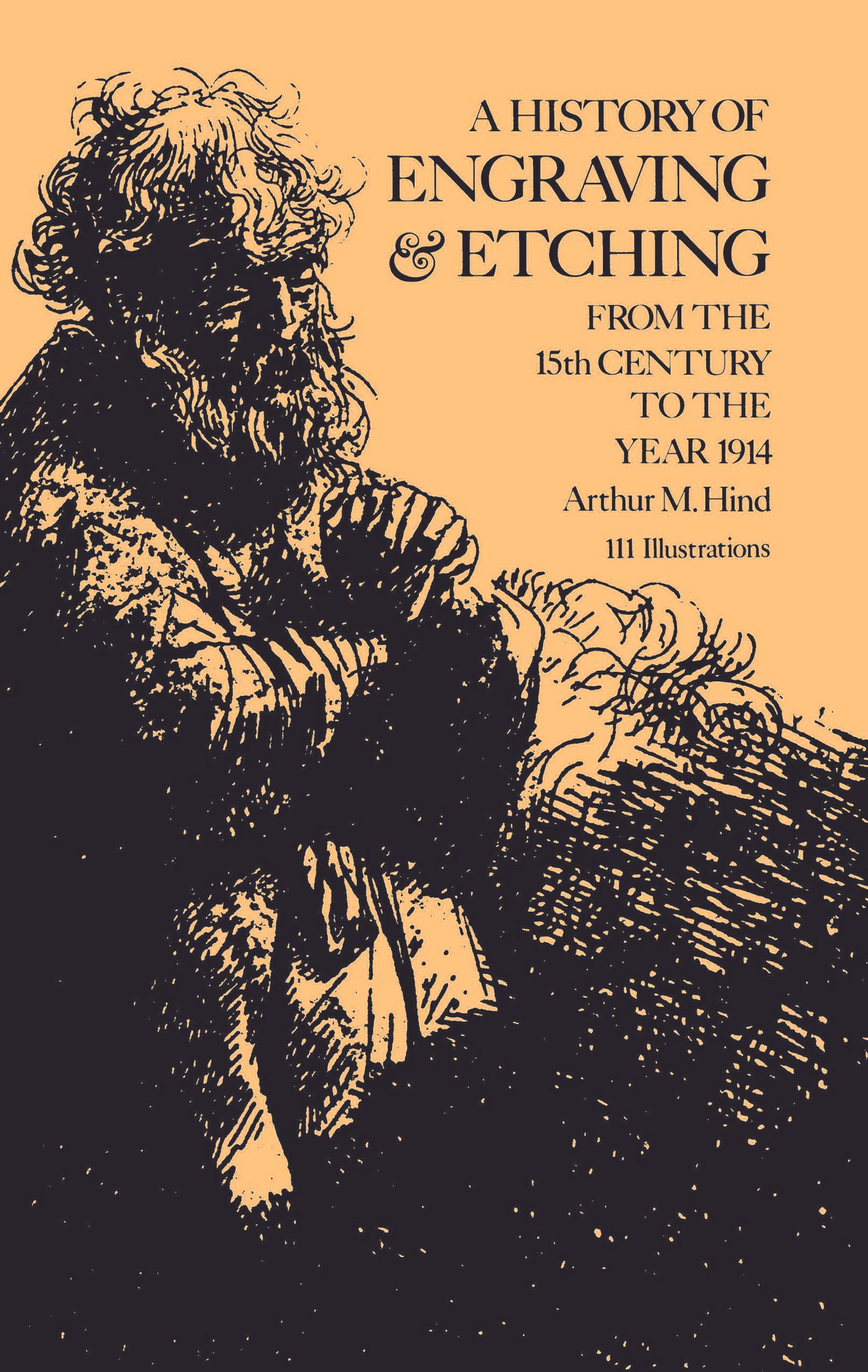
Arthur Mayger Hind (1880–1957) was a leading historian of engraving, one of the most highly respected art historians of modern times. Keeper of Prints and Drawings at the British Museum and Professor of Fine Art at Oxford, he was the author of the most complete history of etching and engraving that has yet been written. This book, formerly out of print for many years, contains references to every etcher or engraver worthy of mention from the early fifteenth century to 1914, and it gives a fair account of influences, artistic repercussions, and accomplishments of each individual.
Beginning with a chapter on processes and methods of the twin arts, in which he covers line-engraving, etching, biting and stopping-out, tone processes, the tools used in the various methods, and so on, the author proceeds with a text that is fabled among artists, art historians, teachers, and students for its richness of detail and the brilliance of its author’s obvious genius for research and criticism. He begins with the anonymous engravers of the fifteenth century, moves through Holland, Italy, and Germany to the great masters of engraving and the beginnings of etching in the sixteenth century, through the portrait engravers, master etchers, the practitioners of mezzotint, aquatint, crayon manner and stipple, and color print makers, to modern etching in the period prior to World War I. All along the way there are illustrations: over 100 magnificent works by Dürer, Finiguerra, Cranach, Lucas Van Leyden, Parmigiano, Van Dyck, Rembrandt, van Ruysdael, Blake, Tiepolo, Piranesi, Turner, Boucher, Goya, Millet, Whistler, and scores of others. All but seven of these plates have been reproduced from new photographs and are even sharper and clearer than those in the original editions of Hind's great text.
As an aid to students of art history, there is a massive Index of more than 2,500 artists mentioned in the text, with their dates and brief individual biographical data. Furthermore, there is a classified chronological list, arranged by country, of important artists, movements, and styles, and the engravers and etchers who were influenced by them. Finally, there is a bibliography that is valuable for further reference work.
Pay easily by card, Klarna, Apple Pay or Google Pay. Not happy? You always have a 14-day money-back guarantee. Read more in our terms. If you have any questions, email us at hello@memmo.org.
Memmo makes studying easier – wherever you are in the world. We bring your course books and smart study tools together in one place: summaries, quizzes, podcasts and flashcards. Plus Ted, your study buddy who answers anything you wonder. Over 50,000 students already study here – built to help you learn faster and stress less.