
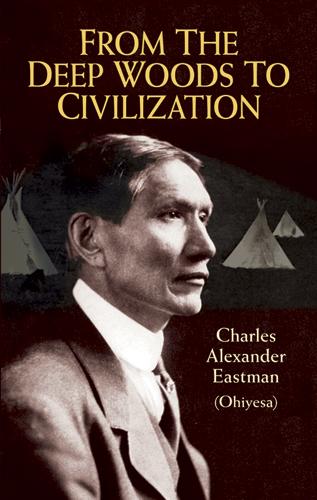
"Has a many-sided appeal …. This stimulating book is one of the few that really deserve the over-worked term, a human document." — Publishers Weekly.
In the first of his memoirs, the popular Indian Boyhood, Charles Alexander Eastman recounted his traditional upbringing among the Santee Sioux. From the Deep Woods to Civilization resumes his story, recounting his abrupt departure from tribal life at age 15 to pursue his education among whites — a path that led him to certification as a medical doctor, the publication of many successful books, and a lifetime of tireless efforts to benefit his native culture. Through his social work and his writings, Eastman became one of the best-known Indians of the early twentieth century and an important force in interpreting and relating the spiritual depth and greatness of the Native American traditions.
Eastman became a physician in hopes of serving the Native American community; he received a Bachelor of Science degree from Dartmouth in 1887 and a medical degree from Boston University in 1890. He began college just a few months after the Battle of Little Bighorn, and his first job as a physician at Pine Ridge Reservation coincided with the Ghost Dance uprisings that culminated in the U. S. Army's attack at Wounded Knee. The only doctor available to assist the massacre's victims, Eastman writes movingly of the event's appalling inhumanity and injustice. Afterward, he lobbied Capitol Hill on behalf of the Sioux and devoted the rest of his life, both in and out of government service, to helping Indians adapt to the white world while retaining the best of their own culture. His autobiography resonates with the impassioned thoughts and experiences of a profound contributor to the richness of American culture.
In the first of his memoirs, the popular Indian Boyhood, Charles Alexander Eastman recounted his traditional upbringing among the Santee Sioux. From the Deep Woods to Civilization resumes his story, recounting his abrupt departure from tribal life at age 15 to pursue his education among whites — a path that led him to certification as a medical doctor, the publication of many successful books, and a lifetime of tireless efforts to benefit his native culture. Through his social work and his writings, Eastman became one of the best-known Indians of the early twentieth century and an important force in interpreting and relating the spiritual depth and greatness of the Native American traditions.
Eastman became a physician in hopes of serving the Native American community; he received a Bachelor of Science degree from Dartmouth in 1887 and a medical degree from Boston University in 1890. He began college just a few months after the Battle of Little Bighorn, and his first job as a physician at Pine Ridge Reservation coincided with the Ghost Dance uprisings that culminated in the U. S. Army's attack at Wounded Knee. The only doctor available to assist the massacre's victims, Eastman writes movingly of the event's appalling inhumanity and injustice. Afterward, he lobbied Capitol Hill on behalf of the Sioux and devoted the rest of his life, both in and out of government service, to helping Indians adapt to the white world while retaining the best of their own culture. His autobiography resonates with the impassioned thoughts and experiences of a profound contributor to the richness of American culture.
Pages: 128
Category: Biografi & Memoarer
e-ISBN: 9780486147031
Shipping weight: 1.2 kg
Ships in: 1-2 days
Pay easily by card, Klarna, Apple Pay or Google Pay. Not happy? You always have a 14-day money-back guarantee. Read more in our terms. If you have any questions, email us at hello@memmo.org.
Memmo makes studying easier – wherever you are in the world. We bring your course books and smart study tools together in one place: summaries, quizzes, podcasts and flashcards. Plus Ted, your study buddy who answers anything you wonder. Over 50,000 students already study here – built to help you learn faster and stress less.
You might also like
Buy the book0