
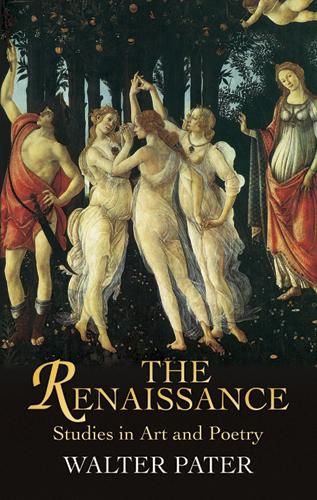
"The golden book of spirit and sense, the holy writ of beauty." — Oscar Wilde
Published to equal parts scandal and acclaim in 1873, The Renaissance inspired a generation of Oxford undergraduates, who adapted its credo of "arts for art's sake" for their Aesthetic Movement. Combining the skepticism of empirical philosophy, the materialism of 19th-century science, and the determinism of evolutionary theory, this book defies categorization and endures as an innovative example of cultural criticism.
An Oxford don who led a quiet scholarly life, Walter Pater was shocked at the reactions his writings provoked. ("I wish they would not call me a hedonist," he remarked, "it gives such a wrong impression to those who do not know Greek.") His essays on the individuals he viewed as embodiments of the Renaissance spirit encompass artists whose careers span the Middle Ages through the 18th century. Pater's elegant, fluid prose examines the works of Pico della Mirandola, Leonardo, Michelangelo, Botticelli, and others. He crowns his compendium of reflections with his notorious Conclusion, in which he asserts that "to burn always with this hard, gemlike flame, to maintain this ecstasy, is success in life."
One of Victorian England's most talked about books, The Renaissance exerted a crucial influence on the art criticism of the past century, and it remains a work of unusual importance to those interested in art history and English literature.
Pay easily by card, Klarna, Apple Pay or Google Pay. Not happy? You always have a 14-day money-back guarantee. Read more in our terms. If you have any questions, email us at hello@memmo.org.
Memmo makes studying easier – wherever you are in the world. We bring your course books and smart study tools together in one place: summaries, quizzes, podcasts and flashcards. Plus Ted, your study buddy who answers anything you wonder. Over 50,000 students already study here – built to help you learn faster and stress less.