
"The book is a pleasure to read. There is no question but that it will become, and deserves to be, a widely used textbook and reference." — Bulletin of the American Mathematical Society.
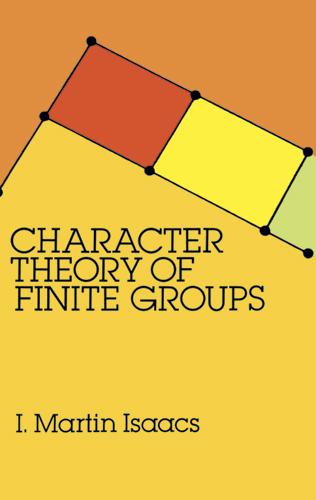
Character theory provides a powerful tool for proving theorems about finite groups. In addition to dealing with techniques for applying characters to "pure" group theory, a large part of this book is devoted to the properties of the characters themselves and how these properties reflect and are reflected in the structure of the group.
Chapter I consists of ring theoretic preliminaries. Chapters 2 to 6 and 8 contain the basic material of character theory, while Chapter 7 treats an important technique for the application of characters to group theory. Chapter 9 considers irreducible representations over arbitrary fields, leading to a focus on subfields of the complex numbers in Chapter 10. In Chapter 15 the author introduces Brauer’s theory of blocks and "modular characters." Remaining chapters deal with more specialized topics, such as the connections between the set of degrees of the irreducible characters and structure of a group. Following each chapter is a selection of carefully thought out problems, including exercises, examples, further results and extensions and variations of theorems in the text.
Prerequisites for this book are some basic finite group theory: the Sylow theorems, elementary properties of permutation groups and solvable and nilpotent groups. Also useful would be some familiarity with rings and Galois theory. In short, the contents of a first-year graduate algebra course should be sufficient preparation.
Character theory provides a powerful tool for proving theorems about finite groups. In addition to dealing with techniques for applying characters to "pure" group theory, a large part of this book is devoted to the properties of the characters themselves and how these properties reflect and are reflected in the structure of the group.
Chapter I consists of ring theoretic preliminaries. Chapters 2 to 6 and 8 contain the basic material of character theory, while Chapter 7 treats an important technique for the application of characters to group theory. Chapter 9 considers irreducible representations over arbitrary fields, leading to a focus on subfields of the complex numbers in Chapter 10. In Chapter 15 the author introduces Brauer’s theory of blocks and "modular characters." Remaining chapters deal with more specialized topics, such as the connections between the set of degrees of the irreducible characters and structure of a group. Following each chapter is a selection of carefully thought out problems, including exercises, examples, further results and extensions and variations of theorems in the text.
Prerequisites for this book are some basic finite group theory: the Sylow theorems, elementary properties of permutation groups and solvable and nilpotent groups. Also useful would be some familiarity with rings and Galois theory. In short, the contents of a first-year graduate algebra course should be sufficient preparation.
Pay easily by card, Klarna, Apple Pay or Google Pay. Not happy? You always have a 14-day money-back guarantee. Read more in our terms. If you have any questions, email us at hello@memmo.org.
Memmo makes studying easier – wherever you are in the world. We bring your course books and smart study tools together in one place: summaries, quizzes, podcasts and flashcards. Plus Ted, your study buddy who answers anything you wonder. Over 75,000 students already study here – built to help you learn faster and stress less.
You might also like
Buy the book0