
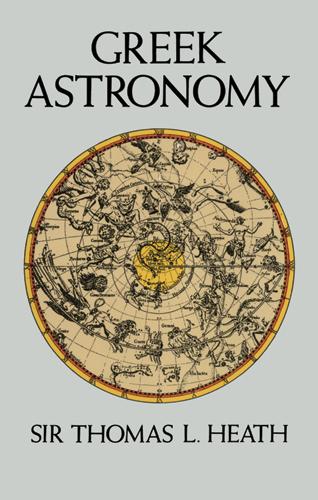
Astronomy as a science began with the Ionian philosophers, with whom Greek philosophy and mathematics also began. While the Egyptians and Babylonians had accomplished much of astronomical worth, it remained for the unrivalled speculative genius of the Greeks, in particular, their mathematical genius, to lay the foundations of the true science of astronomy. In this classic study, a noted scholar discusses in lucid detail the specific advances made by the Greeks, many of whose ideas anticipated the discoveries of modern astronomy.
Pythagoras, born at Samos about 572 B.C., was probably the first to hold that the earth is spherical in shape, while his later followers anticipated Copernicus with the then-startling hypothesis that the earth was not the center of the universe but a planet like the others. Heraclides of Pontus (c. 388–315 B.C.), a pupil of Plato, declared that the apparent daily rotation of the heavenly bodies is due, not to a rotation of the heavenly sphere about an axis through the center of the earth, but to the rotation of the earth itself around its own axis. Secondly, Heraclides discovered that Venus and Mercury revolve around the sun like satellites. Perhaps the greatest astronomer of antiquity was Hipparchus, who flourished between 161 and 126 B.C. He compiled a catalog of fixed stars to the number 850 or more, made great improvements in the instruments used for astronomical observations, and discovered the precession of the equinoxes, among other accomplishments. The astronomy of Hipparchus takes its definitive form in the Syntaxis (commonly called the Almagest) of Ptolemy, written about A.D. 150, which held the field until the time of Copernicus.
The extraordinary achievements of these and many more Greek theorists are given full coverage in this erudite account, which blends exceptional clarity with a readable style to produce a work that is not only indispensable for astronomers and historians of science but easily accessible to science-minded lay readers.
Pay easily by card, Klarna, Apple Pay or Google Pay. Not happy? You always have a 14-day money-back guarantee. Read more in our terms. If you have any questions, email us at hello@memmo.org.
Memmo makes studying easier – wherever you are in the world. We bring your course books and smart study tools together in one place: summaries, quizzes, podcasts and flashcards. Plus Ted, your study buddy who answers anything you wonder. Over 50,000 students already study here – built to help you learn faster and stress less.