
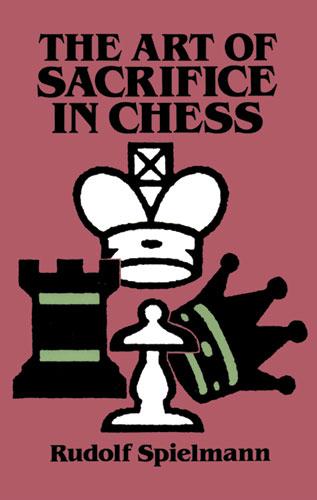
"The beauty of a game of chess is usually appraised, and with good reason, according to the sacrifices it contains. On principle we incline to rate a sacrificial game more highly than a positional game. Instinctively we place the moral value above the scientific. We honor Capablanca, but our hearts beat higher when Morphy’s name is mentioned." — Introduction.
Perhaps the strongest Austrian-born grandmaster of the20th century, Rudolf Spielmann (1883–1942) defeated such world-class opponents as Nimzovich, Tartakower, Bogoljubov — and even the great Capablanca. Among the reasons for his success was his mastery of the art of sacrifice. In this ground-breaking classic, distilled from 40 years of tournament play, he outlines the hard-won lessons that enable a player to win games by giving up pieces!
Drawing on dozens of his own games against such topflight players as Schlechter, Tartakower, Bogoljubov, Reti, Rubinstein and Tarrasch, Spielmann describes and analysis various type of sacrifices: (positional, for gain, mating) and real sacrifices: (for development, obstructive, preventive, line-clearance, vacating, deflecting and more). The result was the first systematic attempt to explain and exploit the theory of chess sacrifice; it remains an extremely helpful and useful weapon in the arsenal of chess players at every level.
Perhaps the strongest Austrian-born grandmaster of the20th century, Rudolf Spielmann (1883–1942) defeated such world-class opponents as Nimzovich, Tartakower, Bogoljubov — and even the great Capablanca. Among the reasons for his success was his mastery of the art of sacrifice. In this ground-breaking classic, distilled from 40 years of tournament play, he outlines the hard-won lessons that enable a player to win games by giving up pieces!
Drawing on dozens of his own games against such topflight players as Schlechter, Tartakower, Bogoljubov, Reti, Rubinstein and Tarrasch, Spielmann describes and analysis various type of sacrifices: (positional, for gain, mating) and real sacrifices: (for development, obstructive, preventive, line-clearance, vacating, deflecting and more). The result was the first systematic attempt to explain and exploit the theory of chess sacrifice; it remains an extremely helpful and useful weapon in the arsenal of chess players at every level.
Pay easily by card, Klarna, Apple Pay or Google Pay. Not happy? You always have a 14-day money-back guarantee. Read more in our terms. If you have any questions, email us at hello@memmo.org.
Memmo makes studying easier – wherever you are in the world. We bring your course books and smart study tools together in one place: summaries, quizzes, podcasts and flashcards. Plus Ted, your study buddy who answers anything you wonder. Over 75,000 students already study here – built to help you learn faster and stress less.
You might also like
Buy the book0