
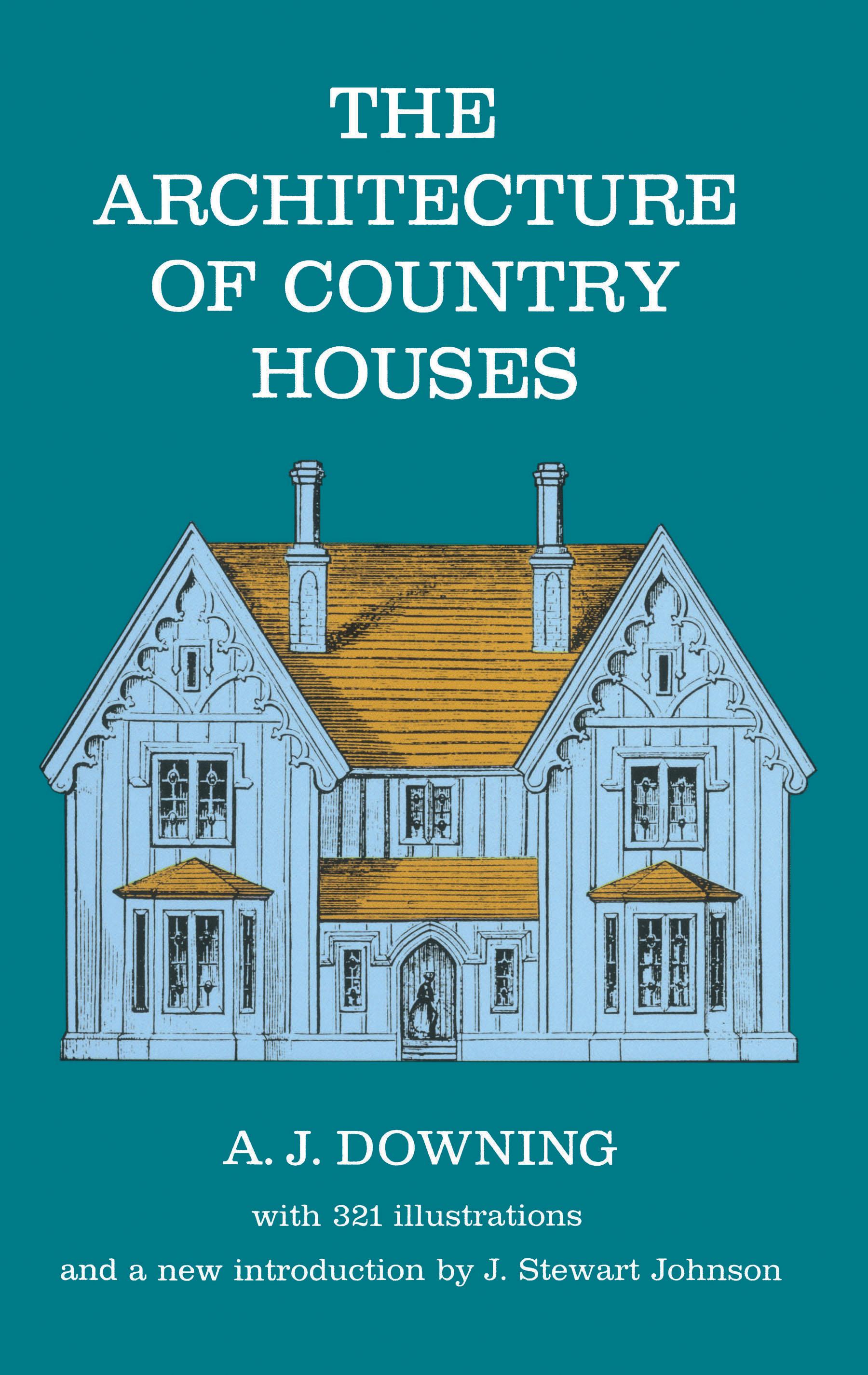
Throughout the early Victorian period, American domestic architecture was dominated by the ideas and designs of Andrew Jackson Downing (1815‒52). Downing, who was America's first important landscape architect, was instrumental in establishing a well-styled, efficient, yet low-priced house that offered many features that previously only mansions could provide. His designs were widely spread both by his books and by periodical republication.
Downing's most important work was his Architecture of Country Houses (1850), which passed through nine editions by 1866 and served as the stylebook for tens, perhaps hundreds of thousands of homes throughout the Eastern United States. It contains 34 designs for model homes (country house in this context simply meaning a separate house, as opposed to a town house), with elevations, floor plans, and discussion of design, construction, and function. The English country house of the period is the ground style, upon which other styles are overlaid; designs showing Gothic, French, Italian, and Elizabethan styles allow the user considerable choice. In many ways these designs form one of the first steps toward the modern house, with avowed emphasis on function and convenience, expression of personality, Catholicism of taste, and concord with environment. Decoration, of course, was not frowned upon.
Most valuable today is the author's full, thorough discussion of many other aspects of the early Victorian house: aesthetic concerns of architecture, adjustment to locality, materials, construction, costs, floor plan, roofing, shingling, painting, chimneys, and fireplaces, interior woodwork, wallpapering, decoration, furnishing, ventilation, sanitation, central heating, and landscaping. Since most of the houses concerned have been destroyed or altered, and practically no living situations have been preserved, this book is indispensable to everyone interested in early American culture, interior decoration, restoration, or Victorian architecture. It is far and away the richest source for the period.
Downing's most important work was his Architecture of Country Houses (1850), which passed through nine editions by 1866 and served as the stylebook for tens, perhaps hundreds of thousands of homes throughout the Eastern United States. It contains 34 designs for model homes (country house in this context simply meaning a separate house, as opposed to a town house), with elevations, floor plans, and discussion of design, construction, and function. The English country house of the period is the ground style, upon which other styles are overlaid; designs showing Gothic, French, Italian, and Elizabethan styles allow the user considerable choice. In many ways these designs form one of the first steps toward the modern house, with avowed emphasis on function and convenience, expression of personality, Catholicism of taste, and concord with environment. Decoration, of course, was not frowned upon.
Most valuable today is the author's full, thorough discussion of many other aspects of the early Victorian house: aesthetic concerns of architecture, adjustment to locality, materials, construction, costs, floor plan, roofing, shingling, painting, chimneys, and fireplaces, interior woodwork, wallpapering, decoration, furnishing, ventilation, sanitation, central heating, and landscaping. Since most of the houses concerned have been destroyed or altered, and practically no living situations have been preserved, this book is indispensable to everyone interested in early American culture, interior decoration, restoration, or Victorian architecture. It is far and away the richest source for the period.
Pay easily by card, Klarna, Apple Pay or Google Pay. Not happy? You always have a 14-day money-back guarantee. Read more in our terms. If you have any questions, email us at hello@memmo.org.
Memmo makes studying easier – wherever you are in the world. We bring your course books and smart study tools together in one place: summaries, quizzes, podcasts and flashcards. Plus Ted, your study buddy who answers anything you wonder. Over 75,000 students already study here – built to help you learn faster and stress less.
You might also like
Buy the book0