
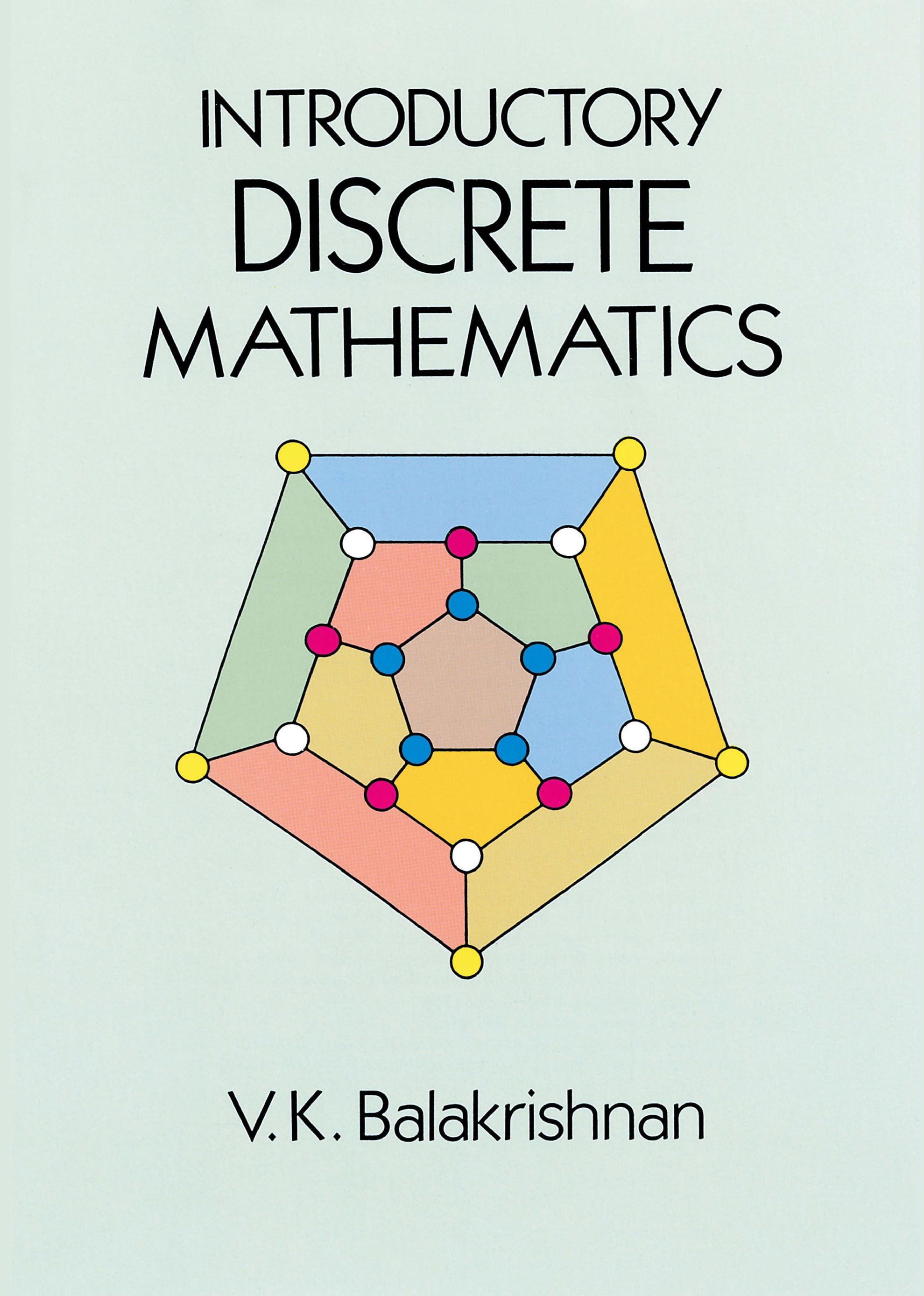
This concise text offers an introduction to discrete mathematics for undergraduate students in computer science and mathematics. Mathematics educators consider it vital that their students be exposed to a course in discrete methods that introduces them to combinatorial mathematics and to algebraic and logical structures focusing on the interplay between computer science and mathematics. The present volume emphasizes combinatorics, graph theory with applications to some stand network optimization problems, and algorithms to solve these problems.
Chapters 0–3 cover fundamental operations involving sets and the principle of mathematical induction, and standard combinatorial topics: basic counting principles, permutations, combinations, the inclusion-exclusion principle, generating functions, recurrence relations, and an introduction to the analysis of algorithms. Applications are emphasized wherever possible and more than 200 exercises at the ends of these chapters help students test their grasp of the material.
Chapters 4 and 5 survey graphs and digraphs, including their connectedness properties, applications of graph coloring, and more, with stress on applications to coding and other related problems. Two important problems in network optimization ― the minimal spanning tree problem and the shortest distance problem ― are covered in the last two chapters. A very brief nontechnical exposition of the theory of computational complexity and NP-completeness is outlined in the appendix.
Chapters 0–3 cover fundamental operations involving sets and the principle of mathematical induction, and standard combinatorial topics: basic counting principles, permutations, combinations, the inclusion-exclusion principle, generating functions, recurrence relations, and an introduction to the analysis of algorithms. Applications are emphasized wherever possible and more than 200 exercises at the ends of these chapters help students test their grasp of the material.
Chapters 4 and 5 survey graphs and digraphs, including their connectedness properties, applications of graph coloring, and more, with stress on applications to coding and other related problems. Two important problems in network optimization ― the minimal spanning tree problem and the shortest distance problem ― are covered in the last two chapters. A very brief nontechnical exposition of the theory of computational complexity and NP-completeness is outlined in the appendix.
Pay easily by card, Klarna, Apple Pay or Google Pay. Not happy? You always have a 14-day money-back guarantee. Read more in our terms. If you have any questions, email us at hello@memmo.org.
Memmo makes studying easier – wherever you are in the world. We bring your course books and smart study tools together in one place: summaries, quizzes, podcasts and flashcards. Plus Ted, your study buddy who answers anything you wonder. Over 75,000 students already study here – built to help you learn faster and stress less.
You might also like
Buy the book0