
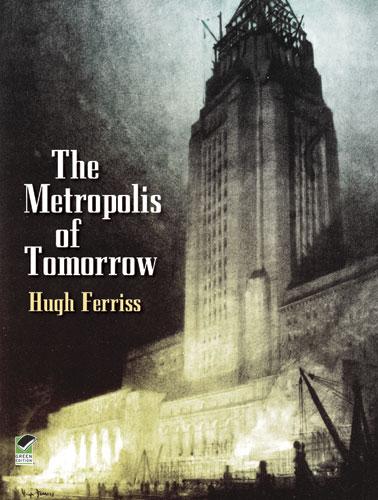
In 1916, New York City enacted zoning laws that mandated the building of “set-back” structures so that light and air would be more freely admitted into the streets below. This concept was first proposed by Louis Sullivan in his 1891 article, “The High-Building Question” (inspired by William Le Baron Jenney’s recently completed Manhattan Building in Chicago.) Hugh Ferriss (1889-1962), American draftsman and architect, studied architecture at Washington University in St. Louis where the Beaux Arts school was favored. Early in his career he worked as a draftsman in the office of Cass Gilbert until he became a freelance delineator. In 1922, Ferris took part in a series of zoning envelope studies that sought to comply with the earlier city legislation. Such were the key ingredients that gave rise to the book at hand.
In The Metropolis of Tomorrow, 49 stunning illustrations depict towering structures, personal space, wide avenues, and rooftop parks — features that now exist in many innovative, densely populated urban landscapes. Ferriss uses metaphors from nature that lend his text a poetic quality. It is no wonder that the work inspired critics of the time to remark: “As a creative entity, as a symbol of the American spirit, it is superb” (Survey), and as “magically stirring as a prophecy” (Albert Guerard in Books).
With its eloquent commentary and powerful renderings, The Metropolis of Tomorrow is an indispensable resource for students, architects, and anyone else with an interest in American architecture.
In The Metropolis of Tomorrow, 49 stunning illustrations depict towering structures, personal space, wide avenues, and rooftop parks — features that now exist in many innovative, densely populated urban landscapes. Ferriss uses metaphors from nature that lend his text a poetic quality. It is no wonder that the work inspired critics of the time to remark: “As a creative entity, as a symbol of the American spirit, it is superb” (Survey), and as “magically stirring as a prophecy” (Albert Guerard in Books).
With its eloquent commentary and powerful renderings, The Metropolis of Tomorrow is an indispensable resource for students, architects, and anyone else with an interest in American architecture.
Pay easily by card, Klarna, Apple Pay or Google Pay. Not happy? You always have a 14-day money-back guarantee. Read more in our terms. If you have any questions, email us at hello@memmo.org.
Memmo makes studying easier – wherever you are in the world. We bring your course books and smart study tools together in one place: summaries, quizzes, podcasts and flashcards. Plus Ted, your study buddy who answers anything you wonder. Over 50,000 students already study here – built to help you learn faster and stress less.
You might also like
Buy the book0