
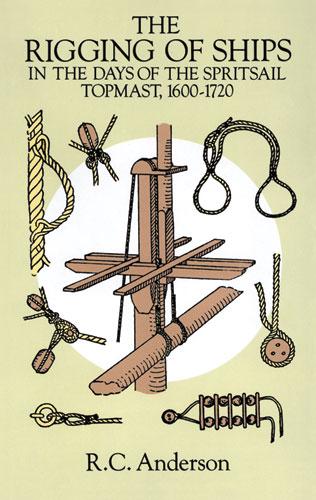
For ship model-makers and students and enthusiasts of historic sailing ships, this generously illustrated book is essential reading and a valuable reference. It describes and depicts in detail how seventeenth-century English, French, Dutch, and other European trading ships and warships were rigged from stem to stern throughout this colorful period in maritime history.
The book begins in 1600, the earliest date of our detailed knowledge of ships’ rigging, and the earliest to which that characteristic seventeenth-century fitting, the spritsail topmast, has been traced. It ends in 1720, roughly the time when the spritsail topmast was superseded by the jib boom and other innovations of eighteenth-century rigging. The book’s 12 chapters cover every aspect of the ship’s rigging of the period, from the lower masts and bowsprit to the running rigging of the topsails and topgallants. Over 350 fine line drawings illustrate every item used in the rigging. Twenty-five halftones, extensively annotated, illustrate typical ships that plied the seas in the days of the bowsprit mast — English merchantmen and gun ships, French and Dutch men-of-war, and more.
In compiling this volume, R. C. Anderson consulted not only the literature of the period, listed in the extensive bibliography, but also famous ship models created throughout the seventeenth century — some with contemporary rigging in almost perfect condition. The result is an indispensable resource for model builders, maritime historians, sailing ship buffs — anyone interested in authentic documentation of ships’ rigging during a crucial period in the history of sailing vessels.
The book begins in 1600, the earliest date of our detailed knowledge of ships’ rigging, and the earliest to which that characteristic seventeenth-century fitting, the spritsail topmast, has been traced. It ends in 1720, roughly the time when the spritsail topmast was superseded by the jib boom and other innovations of eighteenth-century rigging. The book’s 12 chapters cover every aspect of the ship’s rigging of the period, from the lower masts and bowsprit to the running rigging of the topsails and topgallants. Over 350 fine line drawings illustrate every item used in the rigging. Twenty-five halftones, extensively annotated, illustrate typical ships that plied the seas in the days of the bowsprit mast — English merchantmen and gun ships, French and Dutch men-of-war, and more.
In compiling this volume, R. C. Anderson consulted not only the literature of the period, listed in the extensive bibliography, but also famous ship models created throughout the seventeenth century — some with contemporary rigging in almost perfect condition. The result is an indispensable resource for model builders, maritime historians, sailing ship buffs — anyone interested in authentic documentation of ships’ rigging during a crucial period in the history of sailing vessels.
Pay easily by card, Klarna, Apple Pay or Google Pay. Not happy? You always have a 14-day money-back guarantee. Read more in our terms. If you have any questions, email us at hello@memmo.org.
Memmo makes studying easier – wherever you are in the world. We bring your course books and smart study tools together in one place: summaries, quizzes, podcasts and flashcards. Plus Ted, your study buddy who answers anything you wonder. Over 50,000 students already study here – built to help you learn faster and stress less.
You might also like
Buy the book0