
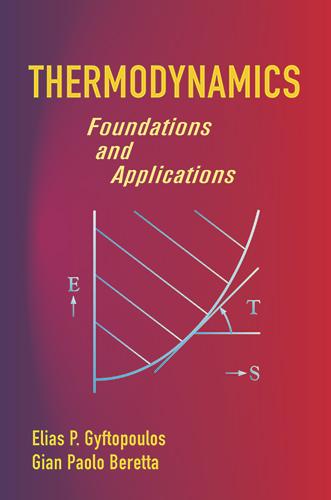
Designed for both undergraduate and graduate students, this authoritative milestone in the foundational development of thermodynamics provides a unique reference for all physicists and engineers. Basic concepts and applications are discussed in complete detail with attention to generality and logical consistency, removing ambiguities and limitations of traditional presentations. Worked-out examples and end-of-chapter problems illustrate the use of energy and entropy balances as powerful analytical keystones in physics and engineering.
The text provides material for undergraduate and graduate courses. At the introductory level, it covers heat engines, stable-equilibrium-state models for ideal-gas, incompressible-fluid and solid behaviors, heat, work and bulk-flow interactions, thermodynamic efficiency, energy conversion systems, energy, and availability/ At the intermediate level, it covers ideal and nonideal mixtures, chemical reactions, chemical equilibrium, and combustion.
At the advanced level, the unique non-traditional order of exposition of the basic concepts and principles (system, property, state, process, first law, energy, equilibrium, stable equilibrium, second law, entropy) allows rigorous general definitions of energy and entropy valid for all systems (large and small, few- and many- particles) and all states (stable and non-stable equilibrium, as well as non-equilibrium). In particular, entropy is defined before and independently of the definitions of temperature and heat, and of the simple-system model for many-particle systems.
The text provides material for undergraduate and graduate courses. At the introductory level, it covers heat engines, stable-equilibrium-state models for ideal-gas, incompressible-fluid and solid behaviors, heat, work and bulk-flow interactions, thermodynamic efficiency, energy conversion systems, energy, and availability/ At the intermediate level, it covers ideal and nonideal mixtures, chemical reactions, chemical equilibrium, and combustion.
At the advanced level, the unique non-traditional order of exposition of the basic concepts and principles (system, property, state, process, first law, energy, equilibrium, stable equilibrium, second law, entropy) allows rigorous general definitions of energy and entropy valid for all systems (large and small, few- and many- particles) and all states (stable and non-stable equilibrium, as well as non-equilibrium). In particular, entropy is defined before and independently of the definitions of temperature and heat, and of the simple-system model for many-particle systems.
Pay easily by card, Klarna, Apple Pay or Google Pay. Not happy? You always have a 14-day money-back guarantee. Read more in our terms. If you have any questions, email us at hello@memmo.org.
Memmo makes studying easier – wherever you are in the world. We bring your course books and smart study tools together in one place: summaries, quizzes, podcasts and flashcards. Plus Ted, your study buddy who answers anything you wonder. Over 50,000 students already study here – built to help you learn faster and stress less.
You might also like
Buy the book0