
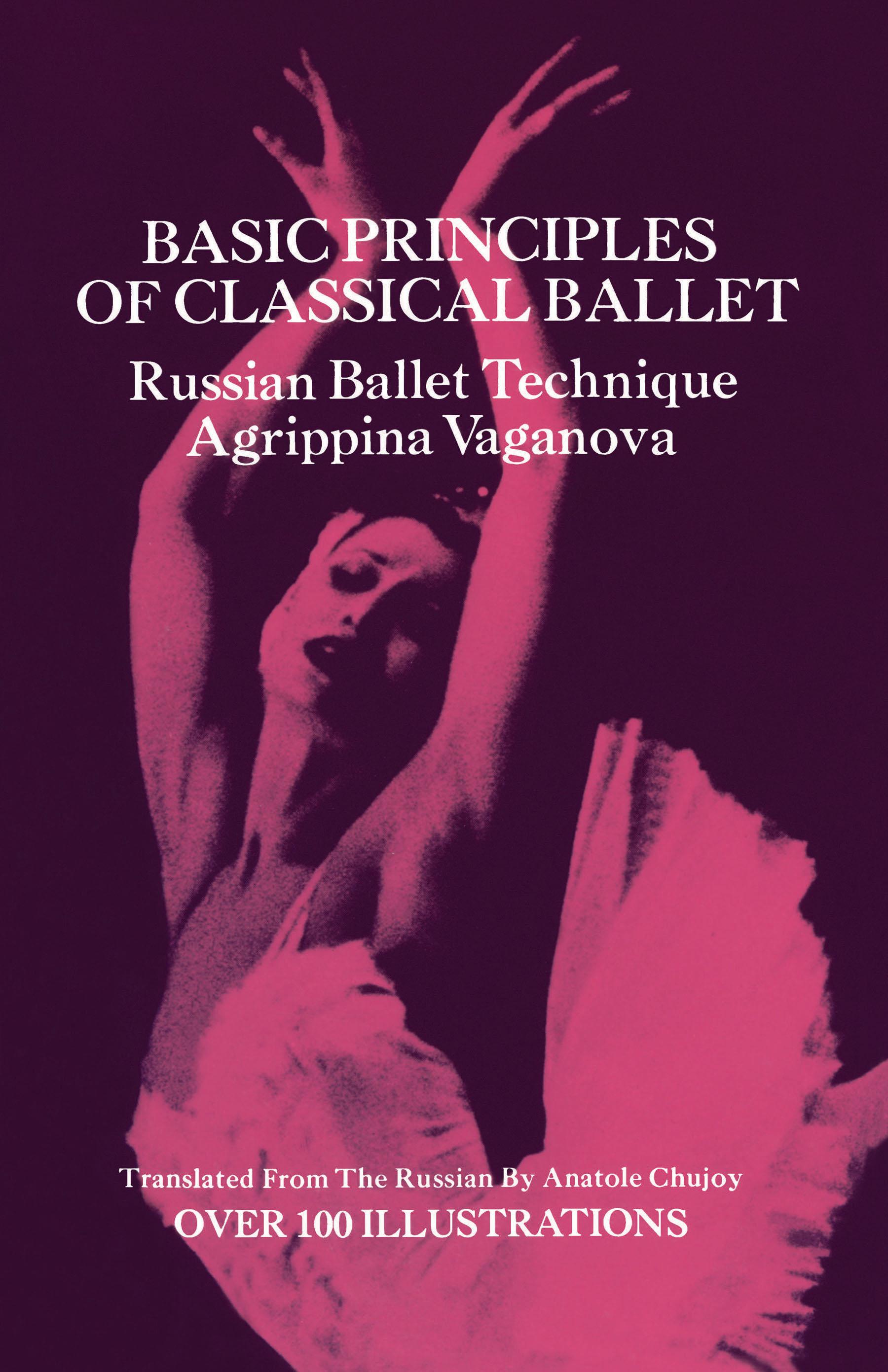
Although the stars of Russian ballet Anna Pavlova and Tamara Karsavina possessed a national manner of dancing, there was no truly Russian school of dancing until the 1930s. The development of this school was largely due to Mme. Vaganova (1879–1951), not only a great dancer but also the teacher of Galina Ulanova and many others and an unsurpassed theoretician.
The principles of Vaganova's system are presented in this well-known book. Mme. Vaganova's aim of creating a personal approach to the Russian dance was based on the critical assimilation of the experience of her contemporaries. Her ability to choose the best of what had been accomplished in the various ballet traditions (French, Italian, and Russian) and combine these into a unified teaching practice in itself amounted to a new school of dance. She firmly believed that the teaching process should be a planned exercise, ever changing with innovations in the dance. She sought from her pupils emotional expressiveness, strictness of form, a resolute, energetic manner of performance, and the understanding of the underlying coordination of movements.
Her book discusses all basic principles of ballet, grouping movements by fundamental types. Chapters cover battements, rotary movements of the legs, the arms, poses of the classical dance, connecting and auxiliary movements, jumps, beats, point work, and turns as well as material for a sample lesson. Diagrams show clearly the exact foot, leg, arm, and body positions for the proper execution of many steps and movements. The result is a fundamental theory of dance that offers dancers, teachers, and ballet lovers information often difficult to locate in other books.
118 illustrations.
Pay easily by card, Klarna, Apple Pay or Google Pay. Not happy? You always have a 14-day money-back guarantee. Read more in our terms. If you have any questions, email us at hello@memmo.org.
Memmo makes studying easier – wherever you are in the world. We bring your course books and smart study tools together in one place: summaries, quizzes, podcasts and flashcards. Plus Ted, your study buddy who answers anything you wonder. Over 75,000 students already study here – built to help you learn faster and stress less.