
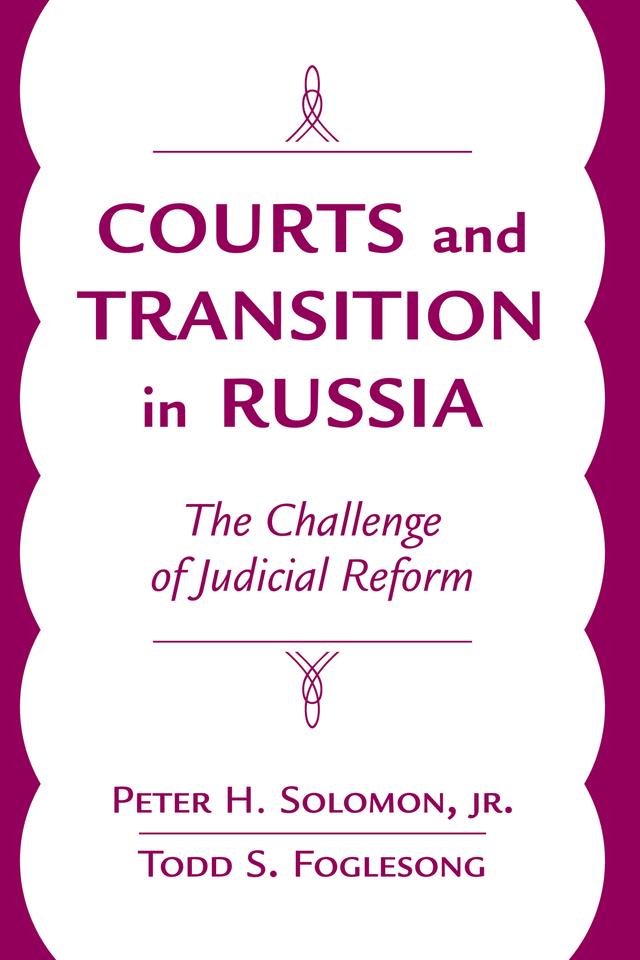
It is hardly a revelation to say that in the Soviet Union, law served not as the foundation of government but as an instrument of rule, or that the judiciary in that country was highly dependent upon political authority. Yet, experience shows that effective democracies and market economies alike require courts that are independent and trusted. In Courts and Transition in Russia, Solomon and Foglesong analyze the state and operation of the courts in Russia and the in some ways remarkable progress of their reform since the end of Soviet power. Particular attention is paid to the struggles of reformers to develop judicial independence and to extend the jurisdiction of the courts to include constitutional and administrative disputes as well as supervision of pretrial investigations. The authors then outline what can and should be done to make courts in Russia autonomous, powerful, reliable, efficient, accessible and fair. The book draws upon extensive field research in Russia, including the results of a lengthy questionnaire distributed to district court judges throughout Russian Federation.Written in a clear and direct manner, Courts and Transition in Russia should appeal to anyone interested in law, politics, or business in Russia ? scholars and practitioners alike ? as well as to students of comparative law, legal transition, and courts in new democracies.
Pay easily by card, Klarna, Apple Pay or Google Pay. Not happy? You always have a 14-day money-back guarantee. Read more in our terms. If you have any questions, email us at hello@memmo.org.
Memmo makes studying easier – wherever you are in the world. We bring your course books and smart study tools together in one place: summaries, quizzes, podcasts and flashcards. Plus Ted, your study buddy who answers anything you wonder. Over 50,000 students already study here – built to help you learn faster and stress less.
You might also like
Buy the book0