
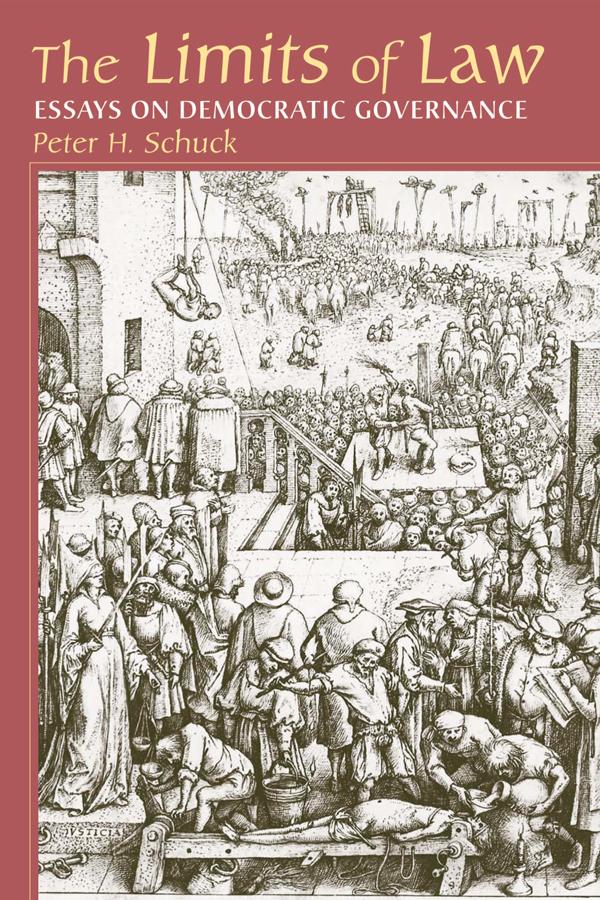
Law is an increasingly pervasive force in our society. At the same time, however, the obstacles to law’s effectiveness are also growing. In The limits of Law, Yale law professor Peter H, Schuck draws on law, social science, and history to explore this momentous clash between law’s compelling promise of ordered liberty and the realistic limits of its capacity to deliver on this promise. Schuck first discusses the constraints within which law must work–law’s own complexity, the cultural chasms it must bridge, and the social diversity it must accommodate–and proceeds to consider the ways law uses regulatory, legislative, and adjudicatory processes to influence social behavior. He shows how politics shapes regulation, how regulation might incorporate individualized equity, and how it can best be reformed. Turning to legislation, he justifies a strong role for special interest groups, dissects purely symbolic statutes, and defends broad delegations of legislative power to regulatory agencies. Concerning adjudication, Schuck analyzes the courts’ efforts to advance social justice by controlling federal agencies, constitutionalizing politics, managing mass toxic tort disputes, and reforming public services and institutions. His concluding chapter draws together some general lessons about law’s limits and possibilities for improving democratic governance.
Pay easily by card, Klarna, Apple Pay or Google Pay. Not happy? You always have a 14-day money-back guarantee. Read more in our terms. If you have any questions, email us at hello@memmo.org.
Memmo makes studying easier – wherever you are in the world. We bring your course books and smart study tools together in one place: summaries, quizzes, podcasts and flashcards. Plus Ted, your study buddy who answers anything you wonder. Over 50,000 students already study here – built to help you learn faster and stress less.
You might also like
Buy the book0