
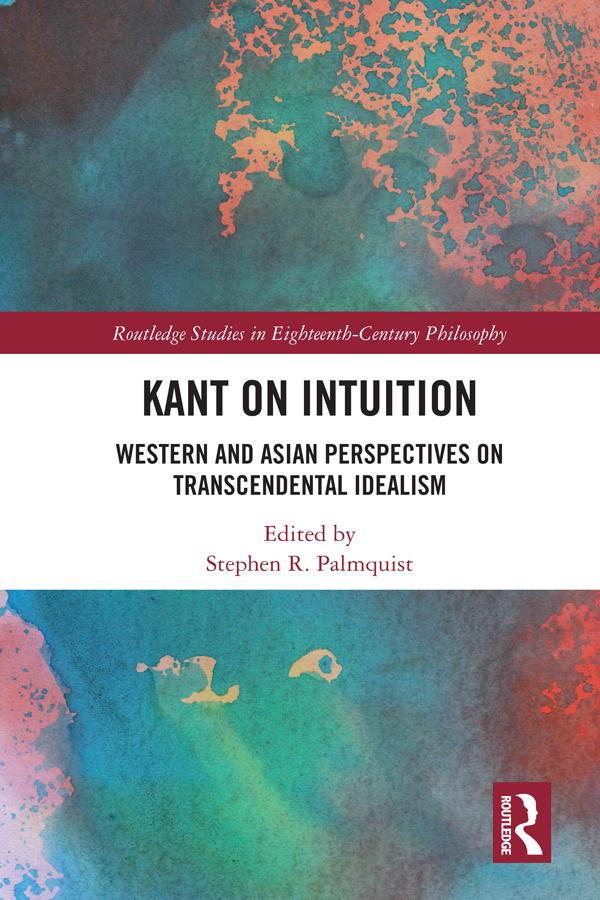
Kant on Intuition: Western and Asian Perspectives on Transcendental Idealism consists of 20 chapters, many of which feature engagements between Kant and various Asian philosophers. Key themes include the nature of human intuition (not only as theoretical—pure, sensible, and possibly intellectual—but also as relevant to Kant’s practical philosophy, aesthetics, the sublime, and even mysticism), the status of Kant’s idealism/realism, and Kant’s notion of an object. Roughly half of the chapters take a stance on the recent conceptualism/non-conceptualism debate. The chapters are organized into four parts, each with five chapters. Part I explores themes relating primarily to the early sections of Kant’s first Critique: three chapters focus mainly on Kant’s theory of the "forms of intuition" and/or "formal intuition", especially as illustrated by geometry, while two examine the broader role of intuition in transcendental idealism. Part II continues to examine themes from the Aesthetic but shifts the main focus to the Transcendental Analytic, where the key question challenging interpreters is to determine whether intuition (via sensibility) is ever capable of operating independently from conception (via understanding); each contributor offers a defense of either the conceptualist or the non-conceptualist readings of Kant’s text. Part III includes three chapters that explore the relevance of intuition to Kant’s theory of the sublime, followed by two that examine challenges that Asian philosophers have raised against Kant’s theory of intuition, particularly as it relates to our experience of the supersensible. Finally, Part IV concludes the book with five chapters that explore a range of resonances between Kant and various Asian philosophers and philosophical ideas.
Pay easily by card, Klarna, Apple Pay or Google Pay. Not happy? You always have a 14-day money-back guarantee. Read more in our terms. If you have any questions, email us at hello@memmo.org.
Memmo makes studying easier – wherever you are in the world. We bring your course books and smart study tools together in one place: summaries, quizzes, podcasts and flashcards. Plus Ted, your study buddy who answers anything you wonder. Over 50,000 students already study here – built to help you learn faster and stress less.