
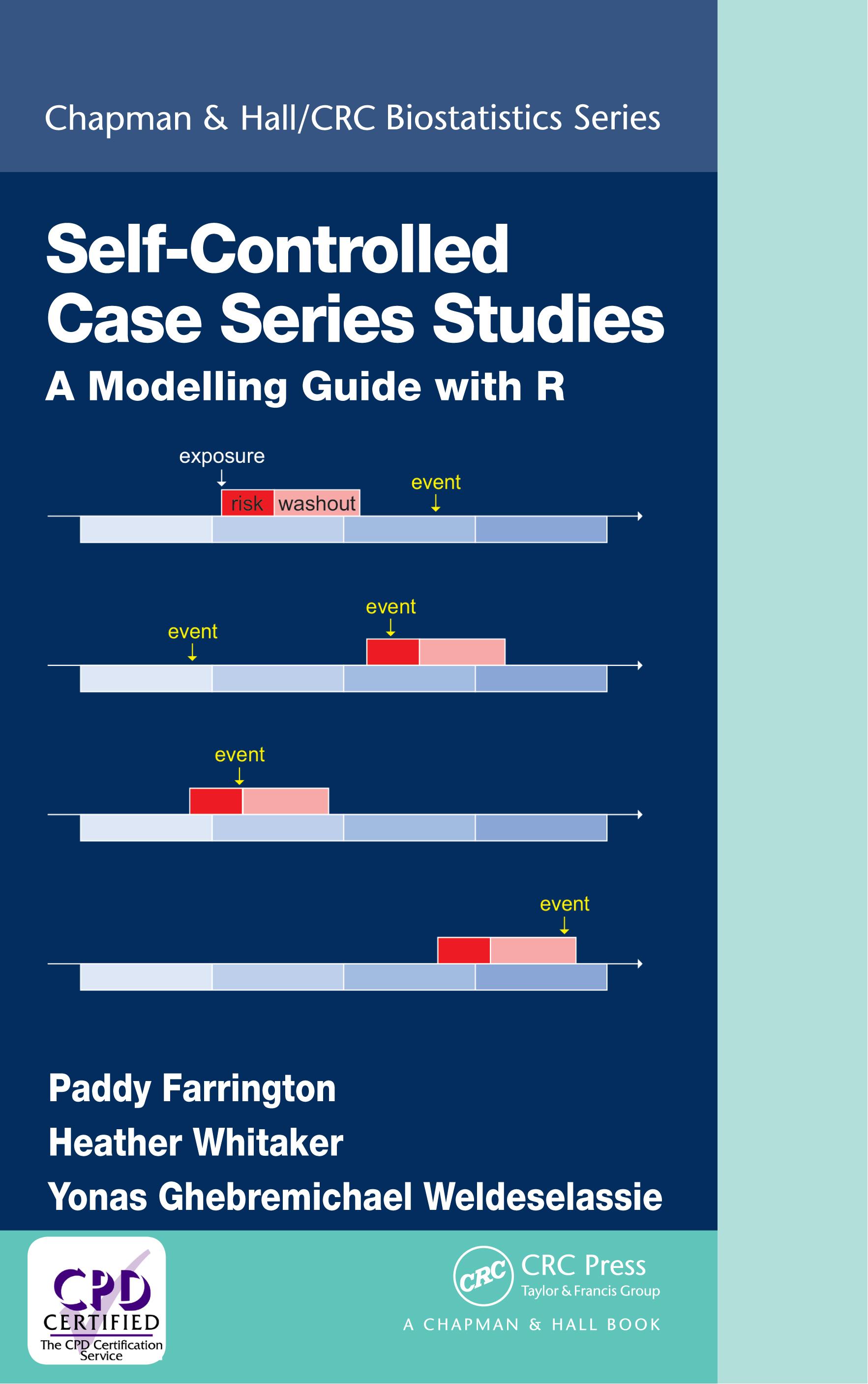
Self-Controlled Case Series Studies: A Modelling Guide with R provides the first comprehensive account of the self-controlled case series (SCCS) method, a statistical technique for investigating associations between outcome events and time-varying exposures. The method only requires information from individuals who have experienced the event of interest, and automatically controls for multiplicative time-invariant confounders, even when these are unmeasured or unknown. It is increasingly being used in epidemiology, most frequently to study the safety of vaccines and pharmaceutical drugs.
Key features of the book include:
- A thorough yet accessible description of the SCCS method, with mathematical details provided in separate starred sections.
- Comprehensive discussion of assumptions and how they may be verified.
- A detailed account of different SCCS models, extensions of the SCCS method, and the design of SCCS studies.
- Extensive practical illustrations and worked examples from epidemiology.
- Full computer code from the associated R package SCCS, which includes all the data sets used in the book.
The book is aimed at a broad range of readers, including epidemiologists and medical statisticians who wish to use the SCCS method, and also researchers with an interest in statistical methodology. The three authors have been closely involved with the inception, development, popularisation and programming of the SCCS method.
Pay easily by card, Klarna, Apple Pay or Google Pay. Not happy? You always have a 14-day money-back guarantee. Read more in our terms. If you have any questions, email us at hello@memmo.org.
Memmo makes studying easier – wherever you are in the world. We bring your course books and smart study tools together in one place: summaries, quizzes, podcasts and flashcards. Plus Ted, your study buddy who answers anything you wonder. Over 75,000 students already study here – built to help you learn faster and stress less.