
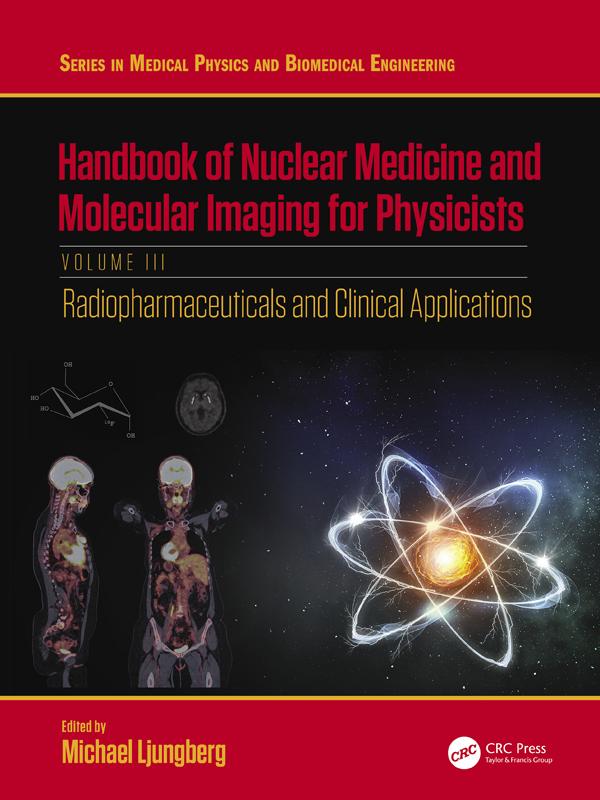
This state-of-the-art handbook, the third and final in a series that provides medical physicists with a comprehensive overview into the field of nuclear medicine, focuses on highlighting the production and application of radiopharmaceuticals. With this, the book also describes the chemical composition of these compounds, as well as some of the main clinical applications where radiopharmaceuticals may be used.
Following an introduction to the field of radiopharmacy, three chapters in this book are dedicated towards in-depth descriptions of common radionuclides and radiopharmaceuticals used during diagnostic studies utilizing planar/Single Photon Emission Computed Tomography (SPECT) imaging, in addition to during Positron Emission Tomography (PET) imaging, and, finally, radiotherapy. These chapters are followed by those describing procedures relating to quality control and manufacturing (good manufacturing practices) also encompassing aspects such as environmental compliance. Furthermore, this volume illustrates how facilities handling these chemicals should be designed to comply with set regulations.
Like many pharmaceuticals, the development of radiopharmaceuticals relies heavily on the use of mouse models. Thus, the translation of radiopharmaceuticals (i.e., the process undertaken to assure that the functionality and safety of a newly developed drug is maintained also in a human context), is covered in a later chapter. This is followed by a chapter emphasising the importance of safe waste disposal and how to assure that these procedures meet the requirements set for the disposal of hazardous waste.
Several chapters have also been dedicated towards describing various medical procedures utilizing clinical nuclear medicine as a tool for diagnostics and therapeutics. As physicists may be involved in clinical trials, a chapter describing the procedures and regulations associated with these types of studies is included. This is followed by a chapter focusing on patient safety and another on an imaging modality not based on ionizing radiation – ultrasound. Finally, the last chapter of this book discusses future perspectives of the field of nuclear medicine.
This text will be an invaluable resource for libraries, institutions, and clinical and academic medical physicists searching for a complete account of what defines nuclear medicine.
- The most comprehensive reference available providing a state-of-the-art overview of the field of nuclear medicine
- Edited by a leader in the field, with contributions from a team of experienced medical physicists, chemists, engineers, scientists, and clinical medical personnel
- Includes the latest practical research in the field, in addition to explaining fundamental theory and the field's history
Pay easily by card, Klarna, Apple Pay or Google Pay. Not happy? You always have a 14-day money-back guarantee. Read more in our terms. If you have any questions, email us at hello@memmo.org.
Memmo makes studying easier – wherever you are in the world. We bring your course books and smart study tools together in one place: summaries, quizzes, podcasts and flashcards. Plus Ted, your study buddy who answers anything you wonder. Over 50,000 students already study here – built to help you learn faster and stress less.