
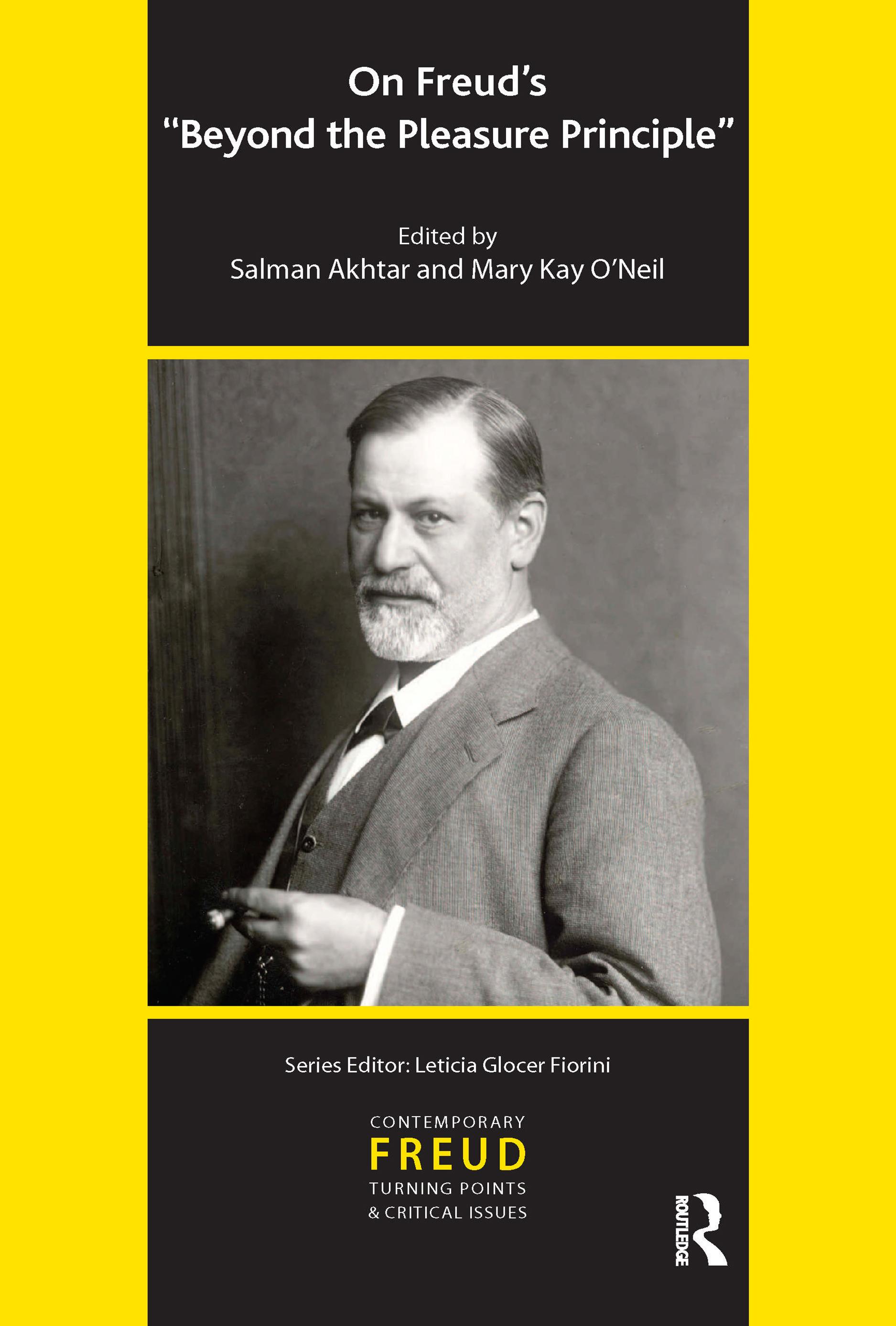
Freud's Beyond the Pleasure Principle constitutes a major landmark and a real turning point in the evolution of psychoanalytic theory. Pushing aside the primacy of the tension-discharge-gratification model of mental dynamics, this work introduced the notion of a "daemonic force" within all human beings that slowly but insistently seeks psychic inactivity, inertia, and death. Politely dismissed by some as a pseudo-biological speculation and rapturously espoused by others as a bold conceptual advance, "death instinct" became a stepping stone to the latter conceptualizations of mind's attacks on itself, negative narcissism, addiction to near-death, and the utter destruction of meaning in some clinical situations. The concept also served as a bridge between the quintessentially Western psychoanalysis and the Eastern perspectives on life and death. These diverse and rich connotations of the proposal are elucidated in On Freud's "Beyond the Pleasure Principle". Other consequences of Freud's 1920 paper - namely, the marginalization of ego instincts and the "upgrading" of aggression in the scheme of things - are also addressed.
Pay easily by card, Klarna, Apple Pay or Google Pay. Not happy? You always have a 14-day money-back guarantee. Read more in our terms. If you have any questions, email us at hello@memmo.org.
Memmo makes studying easier – wherever you are in the world. We bring your course books and smart study tools together in one place: summaries, quizzes, podcasts and flashcards. Plus Ted, your study buddy who answers anything you wonder. Over 50,000 students already study here – built to help you learn faster and stress less.
You might also like
Buy the book0