
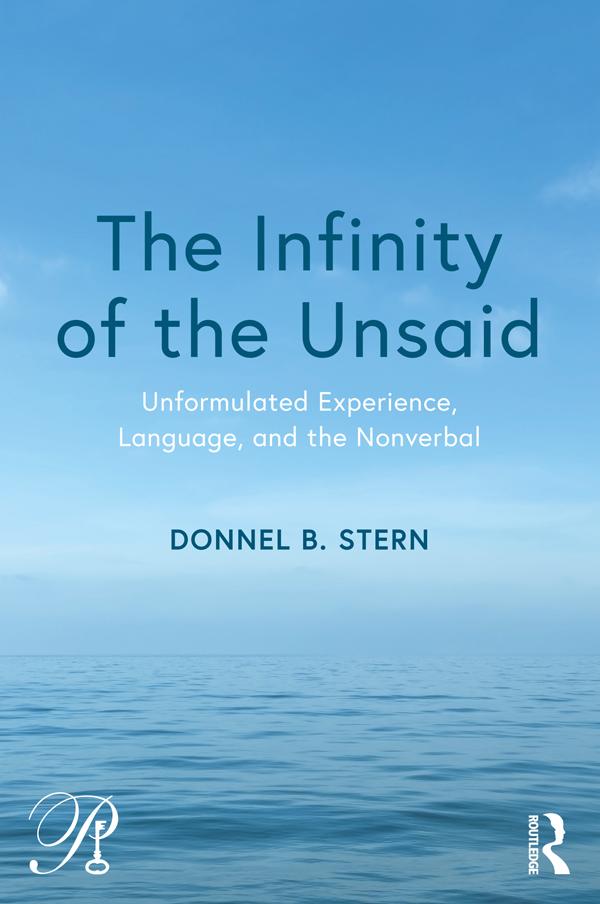
The theory of unformulated experience is an interpersonal/relational conception of unconscious process. The idea is that unconscious content is not fully formed, merely awaiting discovery, but is instead better understood as potential experience—a vaguely organized, primitive, global, non-ideational, affective state.
In the past, the formulation of experience was most commonly understood as verbal articulation. That was the perspective Donnel B. Stern took in 1997 in his first book, Unformulated Experience: From Dissociation to Imagination in Psychoanalysis. In this new book, Stern recognizes that we need to theorize the formulation of nonverbal experience, as well. Using new concepts of the "acceptance" and "use" of experience that "feels like me," Stern argues for a wider conception of "meaningfulness." Some formulated experience is verbal ("articulation"), but other formulations are nonverbal ("realization"). Demonstrating how this can be so is at the heart of this book. Stern then goes on to house this entire set of ideas in the commodious conception of language offered by Charles Taylor, Gadamer, and Merleau-Ponty.
The Infinity of the Unsaid offers an expansion of the theory of unformulated experience that has important implications for clinical thinking and practice; it will be of great interest to psychoanalysts and psychoanalytic psychotherapists across all schools of thought.
Pay easily by card, Klarna, Apple Pay or Google Pay. Not happy? You always have a 14-day money-back guarantee. Read more in our terms. If you have any questions, email us at hello@memmo.org.
Memmo makes studying easier – wherever you are in the world. We bring your course books and smart study tools together in one place: summaries, quizzes, podcasts and flashcards. Plus Ted, your study buddy who answers anything you wonder. Over 50,000 students already study here – built to help you learn faster and stress less.