
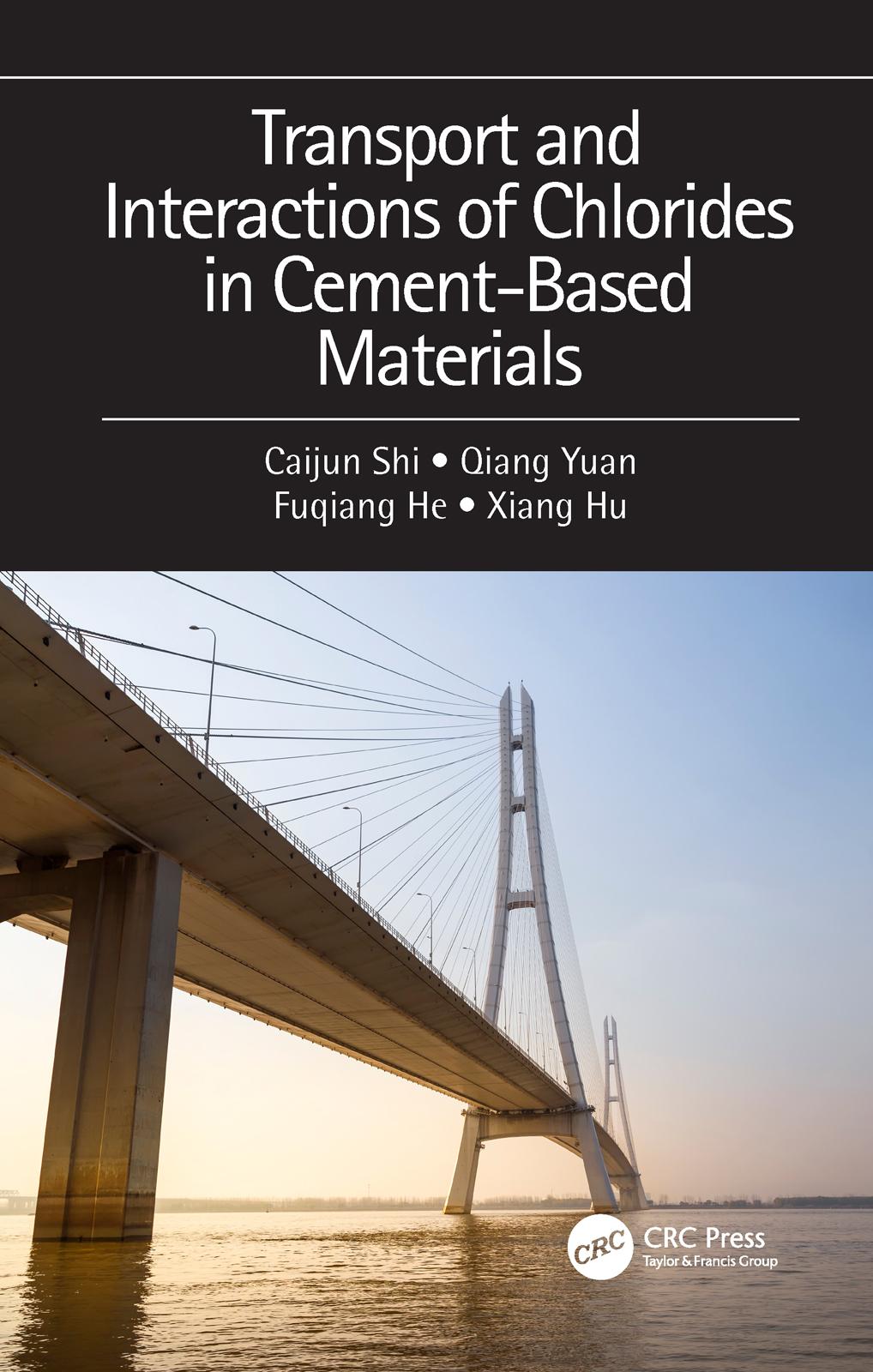
Chloride-induced corrosion is the most important durability issue of reinforced concrete structures, and the prediction and prevention of chloride-induced corrosion has attracted considerable interest all over the world.
Given that chloride penetrates through the concrete cover, the issues concerning its transport are crucial. These include testing methods, prediction, and the prevention of ingress. During the transport process, physical and chemical interaction occurs between chloride and cement hydrates, which in turn affects the further transport, so the transport of chloride and these interactions are closely related and underpin our understanding of chloride-induced corrosion in RC structures.
This book provides in-depth discussion of chloride transport and its interaction in cement-based materials, and reviews and summarizes the state of the art. The mechanisms and testing methods for chloride transport, chemical interactions of chloride with cement hydrates, chloride binding isotherms, measurement of penetration depths, factors affecting chloride transport, and modeling of chloride transport are discussed in detail. This book serves as a reference for researchers or engineer, and a textbook for graduate students.
Pay easily by card, Klarna, Apple Pay or Google Pay. Not happy? You always have a 14-day money-back guarantee. Read more in our terms. If you have any questions, email us at hello@memmo.org.
Memmo makes studying easier – wherever you are in the world. We bring your course books and smart study tools together in one place: summaries, quizzes, podcasts and flashcards. Plus Ted, your study buddy who answers anything you wonder. Over 50,000 students already study here – built to help you learn faster and stress less.