
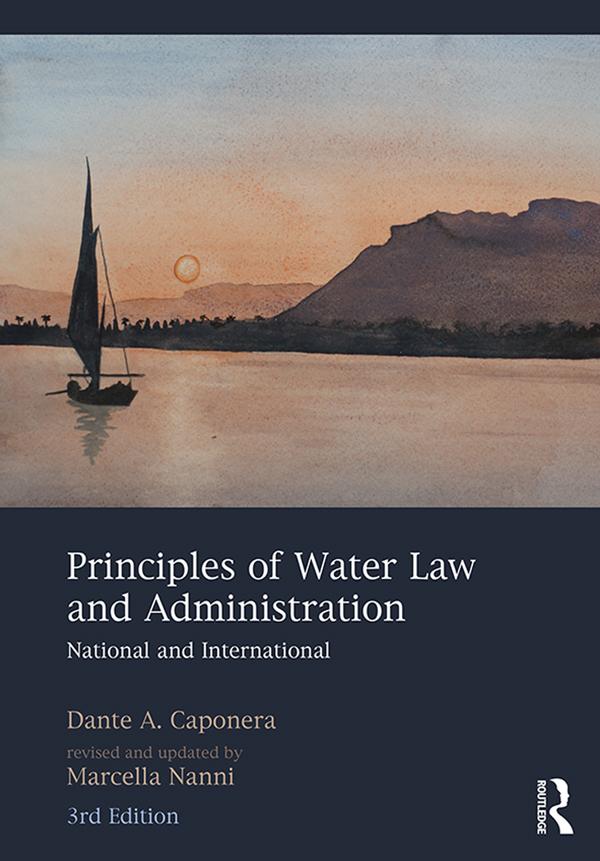
This book, which was first published in 1992 and then updated in 2007, provides a tool for dealing with the legal and institutional aspects of water resources management within national contexts and at the level of transboundary water resources. Like its two previous editions, it seeks to cover all aspects that need to be known in order to attain good water governance, but it provides updates concerning developments since 2007. These relate, inter alia, to the following:
- the “greening” of water law, which calls for the progressive integration of environmental law principles into domestic and international water law;
- the adoption, by the International Law Commission in 2008, of the Draft Articles on the Law of Transboundary Aquifers, and subsequent developments;
- the emergence of the right to water as a self-standing human right;
- the adoption of domestic water laws supporting integrated water resources management (IWRM) and enhanced public participation in planning and decision making;
- the integration into these laws of tools facilitating adaptive water management as a response to climate variability and change;
- progress in the implementation of EU law;
- recent international agreements and judicial decisions;
- efforts of regional organizations other than the EU to steer cooperation in the management of transboundary water resources and the harmonization of national laws;
- institutional mechanisms for the management of transboundary water resources (surface and underground).
Unique in its scope and nature, the book identifies the legal and institutional issues arising in connection with water resources management and provides guidelines for possible solutions in a manner accessible to a wide range of readers. Thus, it is a useful reference for lawyers and non-lawyers — engineers, hydrologists, hydrogeologists, economists, sociologists — dealing with water resources within government institutions, river basin commissions, international organizations, financing institutions and academic institutions, among other things, and also for students of disciplines related to water resources.
Pay easily by card, Klarna, Apple Pay or Google Pay. Not happy? You always have a 14-day money-back guarantee. Read more in our terms. If you have any questions, email us at hello@memmo.org.
Memmo makes studying easier – wherever you are in the world. We bring your course books and smart study tools together in one place: summaries, quizzes, podcasts and flashcards. Plus Ted, your study buddy who answers anything you wonder. Over 50,000 students already study here – built to help you learn faster and stress less.