
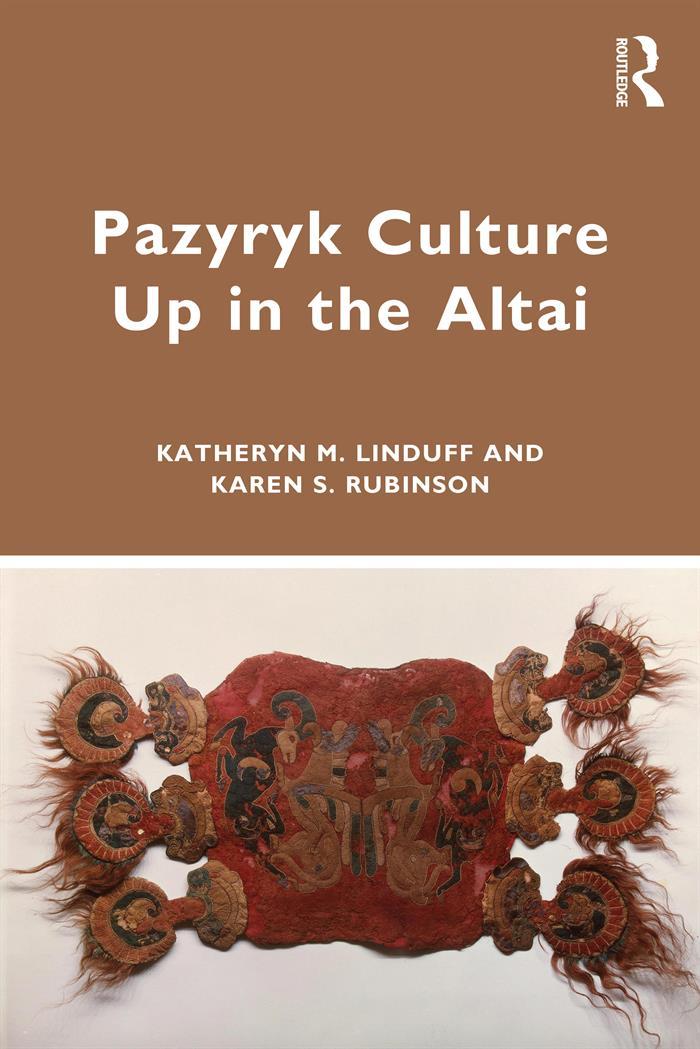
This book reconsiders the archaeology of the Pazyryk, the horse-riding people of the Altai Mountains who lived in the 4th–3rd centuries BCE, in light of recent scientific studies and excavations not only in Russia but also Kazakhstan, Mongolia and China, together with new theories of landscape.
Excavation of the Pazyryk burials sparked great interest because of their wealth of organic remains, including tattooed bodies and sacrificed horses, together with superb wooden carvings and colorful textiles. In view of this new research, the role of the Pazyryk Culture in the ancient globalized world can now be more focused and refined. In this synthetic study of the region, the Pazyryk Culture is set into the landscape using recent studies on climate, technology, human and animal DNA and local resources. It shows that this was a powerful, semi-sedentary, interdependent group with contacts in Eurasia to their west, and to their east in Mongolia and south in China.
This book is for archaeologists, anthropologists, art historians, social and economic historians as well as persons with general interests in mobile pastoralism, the emergence of complex societies, the social roles of artifacts and the diverse nature of an interconnected ancient world.
Pay easily by card, Klarna, Apple Pay or Google Pay. Not happy? You always have a 14-day money-back guarantee. Read more in our terms. If you have any questions, email us at hello@memmo.org.
Memmo makes studying easier – wherever you are in the world. We bring your course books and smart study tools together in one place: summaries, quizzes, podcasts and flashcards. Plus Ted, your study buddy who answers anything you wonder. Over 75,000 students already study here – built to help you learn faster and stress less.