
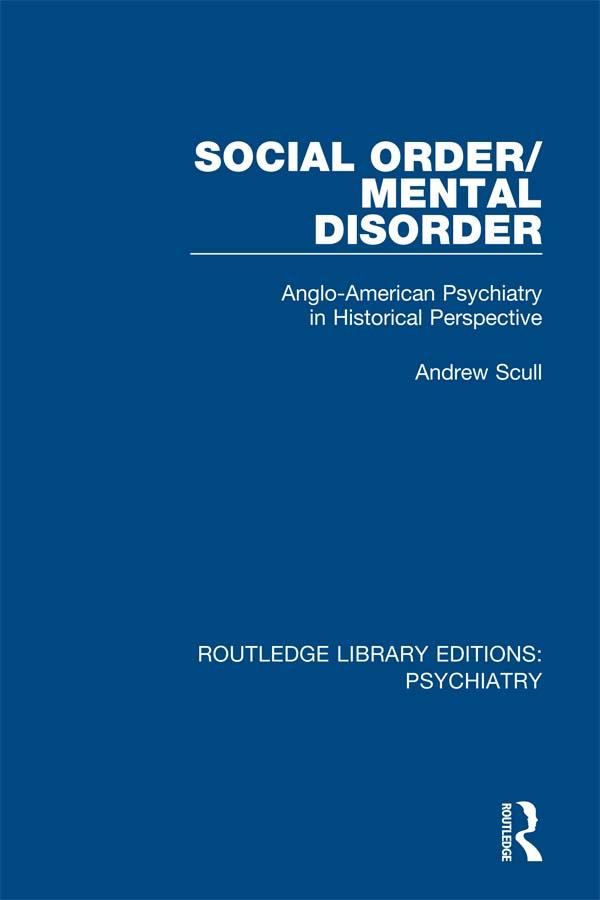
Social Order/Mental Disorder represents a provocative and exciting exploration of social response to madness in England and the United States from the eighteenth through the twentieth centuries. Scull, who is well-known for his previous work in this area, examines a range of issues, including the changing social meanings of madness, the emergence and consolidation of the psychiatric profession, the often troubled relationship between psychiatry and the law, the linkages between sex and madness, and the constitution, character, and collapse of the asylum as our standard response to the problems posed by mental disorder.
This book is emphatically not part of the venerable tradition of hagiography that has celebrated psychiatric history as a long struggle in which the steady application of rational-scientific principles has produced irregular but unmistakable evidence of progress toward humane treatments for the mentally ill. In fact, Scull contends that traditional mental hospitals, for much of their existence, resembled cemeteries for the still breathing, medical hubris having at times served to license dangerous, mutilating, even life-threatening experiments on the dead souls confined therein. He argues that only the sociologically blind would deny that psychiatrists are deeply involved in the definition and identification of what constitutes madness in our world – hence, claims that mental illness is a purely naturalistic category, somehow devoid of contamination by the social, are taken to be patently absurd. Scull points out, however, that the commitment to examine psychiatry and its ministrations with a critical eye by no means entails the romantic idea that the problems it deals with are purely the invention of the professional mind, or the Manichean notion that all psychiatric interventions are malevolent and ill-conceived. It is the task of unromantic criticism that is attempted in this book.
Pay easily by card, Klarna, Apple Pay or Google Pay. Not happy? You always have a 14-day money-back guarantee. Read more in our terms. If you have any questions, email us at hello@memmo.org.
Memmo makes studying easier – wherever you are in the world. We bring your course books and smart study tools together in one place: summaries, quizzes, podcasts and flashcards. Plus Ted, your study buddy who answers anything you wonder. Over 50,000 students already study here – built to help you learn faster and stress less.