
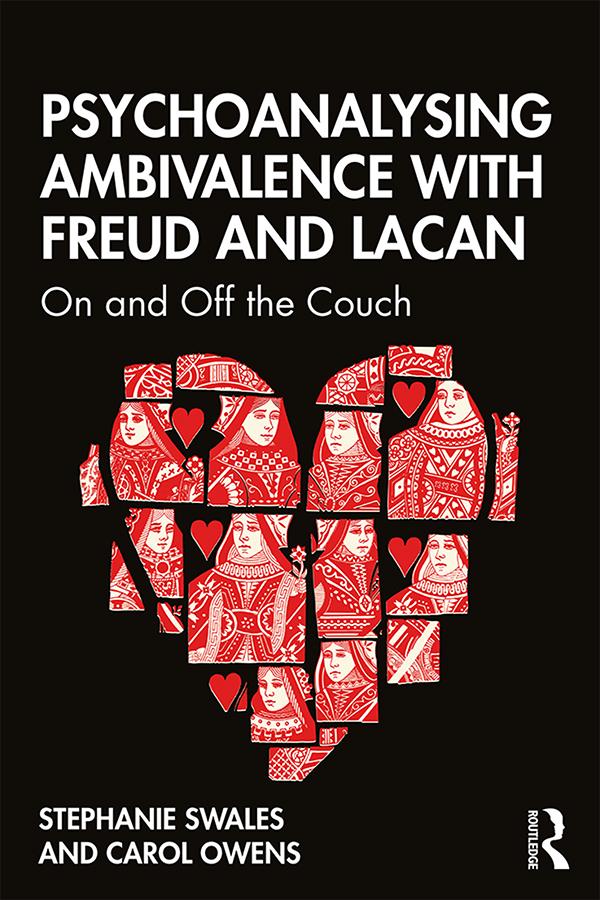
Taking a deep dive into contemporary Western culture, this book suggests we are all fundamentally ambivalent beings. A great deal has been written about how to love – to be kinder, more empathic, a better person, and so on. But trying to love without dealing with our ambivalence, with our hatred, is often a recipe for failure. Any attempt, therefore, to love our neighbour as ourselves – or even, for that matter, to love ourselves – must recognise that we love where we hate and we hate where we love.
Psychoanalysis, beginning with Freud, has claimed that to be in two minds about something or someone is characteristic of human subjectivity. Owens and Swales trace the concept of ambivalence through its various iterations in Freudian and Lacanian psychoanalysis in order to question how the contemporary subject deals with its ambivalence. They argue that experiences of ambivalence are, in present-day cultural life, increasingly excised or foreclosed, and that this foreclosure has symptomatic effects at the individual as well as social level. Owens and Swales examine ambivalence as it is at work in mourning, in matters of sexuality, and in our enjoyment under neoliberalism and capitalism. Above all, the authors consider how today’s ambivalent subject relates to the racially, religiously, culturally, or sexually different neighbour as a result of the current societal dictate of complete tolerance of the other. In this vein, Owens and Swales argue that ambivalence about one’s own jouissance is at the very roots of xenophobia.
Peppered with relevant and stimulating examples from clinical work, film, television, politics, and everyday life, Psychoanalysing Ambivalence breathes new life into an old concept and will appeal to any reader, academic, or clinician with an interest in psychoanalytic ideas.
Pay easily by card, Klarna, Apple Pay or Google Pay. Not happy? You always have a 14-day money-back guarantee. Read more in our terms. If you have any questions, email us at hello@memmo.org.
Memmo makes studying easier – wherever you are in the world. We bring your course books and smart study tools together in one place: summaries, quizzes, podcasts and flashcards. Plus Ted, your study buddy who answers anything you wonder. Over 50,000 students already study here – built to help you learn faster and stress less.