
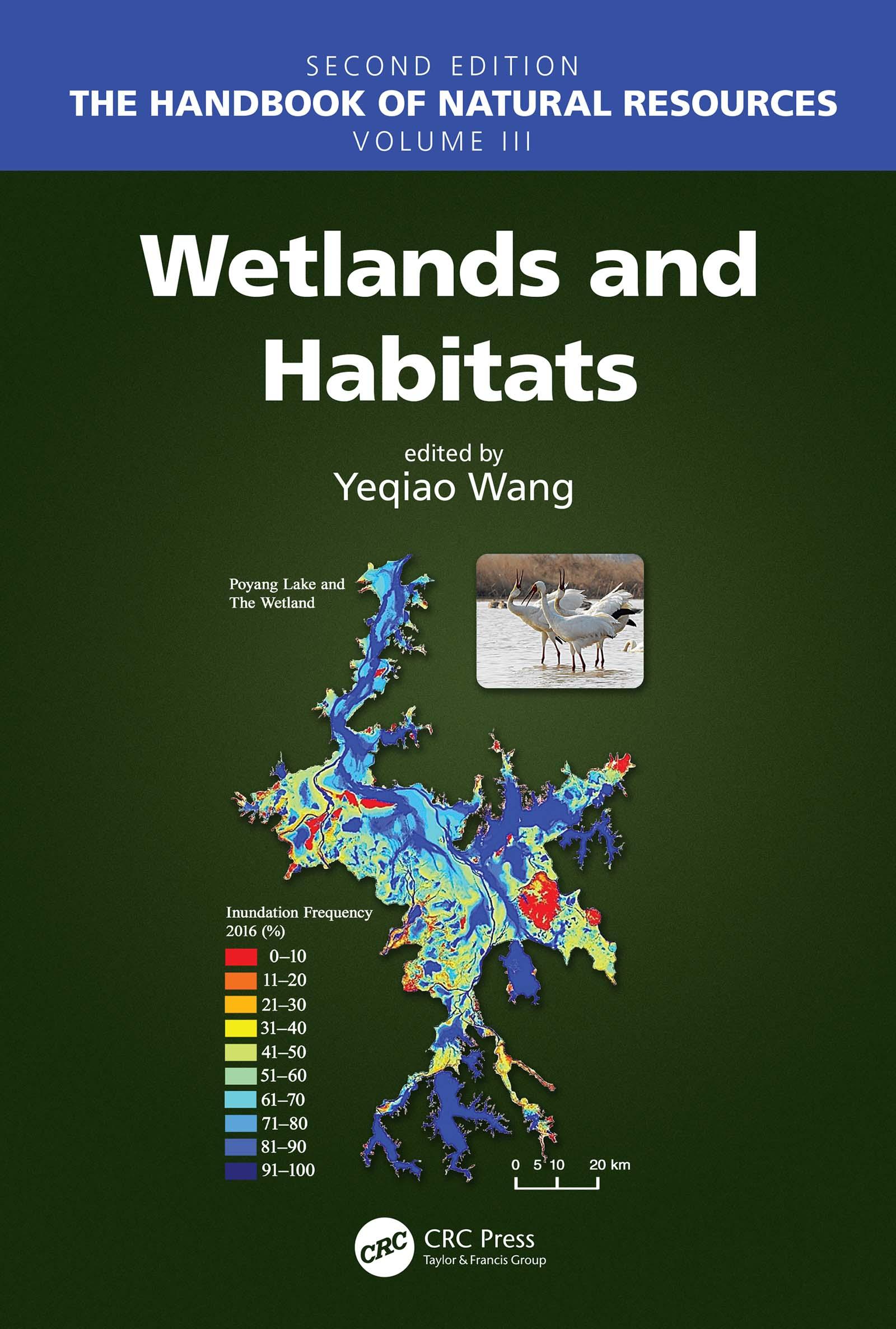
Authored by world-class scientists and scholars, The Handbook of Natural Resources, Second Edition, is an excellent reference for understanding the consequences of changing natural resources to the degradation of ecological integrity and the sustainability of life. Based on the content of the bestselling and CHOICE-awarded Encyclopedia of Natural Resources, this new edition demonstrates the major challenges that the society is facing for the sustainability of all well-being on the planet Earth. The experience, evidence, methods, and models used in studying natural resources are presented in six stand-alone volumes, arranged along the main systems of land, water, and air. It reviews state-of-the-art knowledge, highlights advances made in different areas, and provides guidance for the appropriate use of remote sensing and geospatial data with field-based measurements in the study of natural resources.
Volume 3, Wetlands and Habitats, provides fundamental information on wetlands and their integral functions as a productive ecosystem. The topics it covers include wetlands biodiversity, wetlands classification and monitoring, floods, river ecosystems, pollution, and more. New to this edition are discussions on wetland vegetation, assessment of current wetland health status, restoration, sea-level rises and coastal storm, vulnerability to human impacts, and lakes and wetlands remote sensing. This volume demonstrates the key processes, methods, and models used through many case studies from around the world.
Written in an easy-to-reference manner, The Handbook of Natural Resources, Second Edition, as individual volumes or as a complete set, is an essential reading for anyone looking for a deeper understanding of the science and management of natural resources. Public and private libraries, educational and research institutions, scientists, scholars, and resource managers will benefit enormously from this set. Individual volumes and chapters can also be used in a wide variety of both graduate and undergraduate courses in environmental science and natural science at different levels and disciplines, such as biology, geography, earth system science, and ecology.
Pay easily by card, Klarna, Apple Pay or Google Pay. Not happy? You always have a 14-day money-back guarantee. Read more in our terms. If you have any questions, email us at hello@memmo.org.
Memmo makes studying easier – wherever you are in the world. We bring your course books and smart study tools together in one place: summaries, quizzes, podcasts and flashcards. Plus Ted, your study buddy who answers anything you wonder. Over 50,000 students already study here – built to help you learn faster and stress less.