
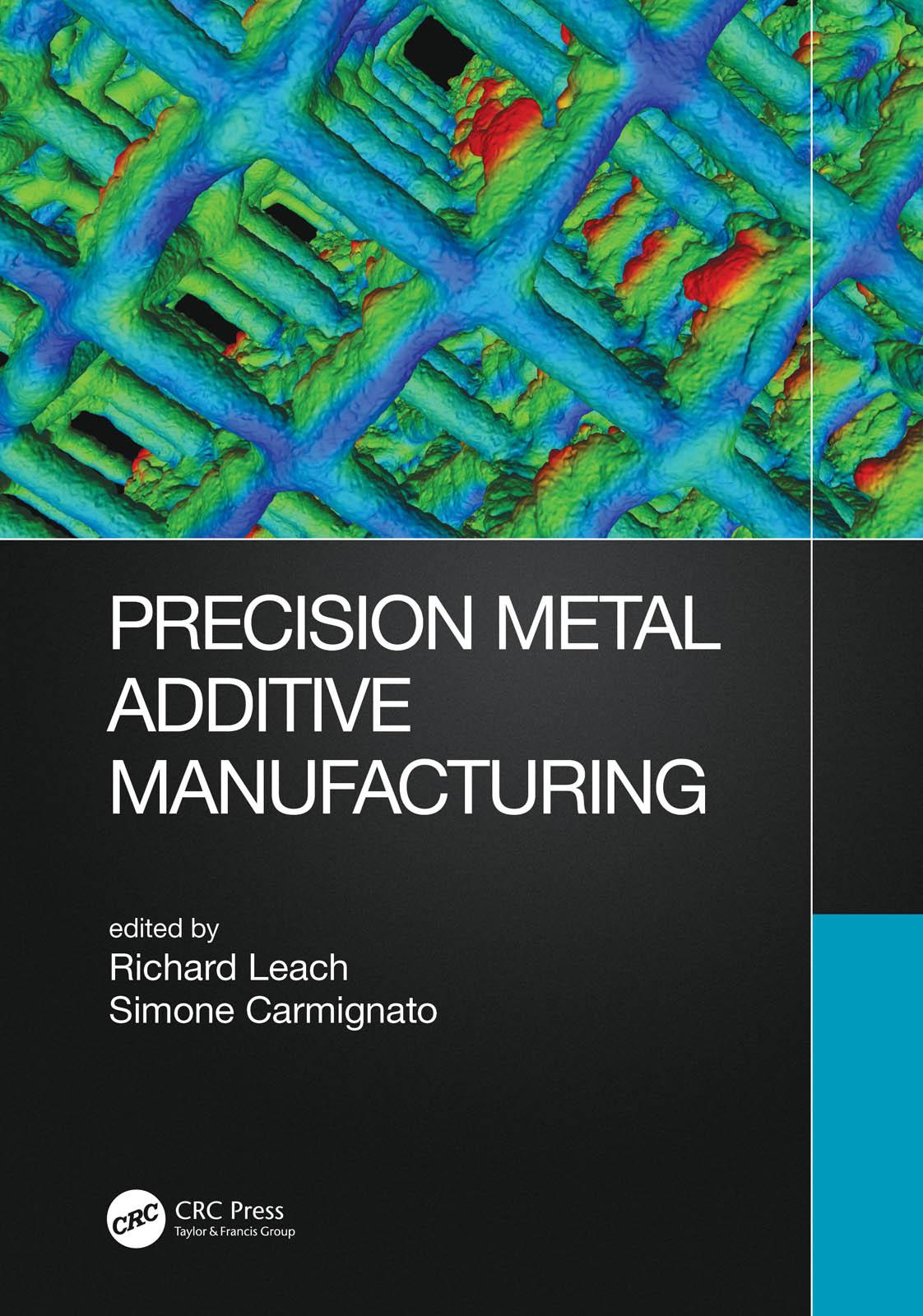
Additive manufacturing (AM) is a fast-growing sector with the ability to evoke a revolution in manufacturing due to its almost unlimited design freedom and its capability to produce personalised parts locally and with efficient material use. AM companies, however, still face technological challenges such as limited precision due to shrinkage, built-in stresses and limited process stability and robustness. Moreover, often post-processing is needed due to high roughness and remaining porosity. Qualified, trained personnel are also in short supply.
In recent years, there have been dramatic improvements in AM design methods, process control, post-processing, material properties and material range. However, if AM is going to gain a significant market share, it must be developed into a true precision manufacturing method. The production of precision parts relies on three principles:
- Production is robust (i.e. all sensitive parameters can be controlled).
- Production is predictable (for example, the shrinkage that occurs is acceptable because it can be predicted and compensated in the design).
- Parts are measurable (as without metrology, accuracy, repeatability and quality assurance cannot be known).
AM of metals is inherently a high-energy process with many sensitive and inter-related process parameters, making it susceptible to thermal distortions, defects and process drift. The complete modelling of these processes is beyond current computational power, and novel methods are needed to practicably predict performance and inform design. In addition, metal AM produces highly textured surfaces and complex surface features that stretch the limits of contemporary metrology. With so many factors to consider, there is a significant shortage of background material on how to inject precision into AM processes. Shortage in such material is an important barrier for a wider uptake of advanced manufacturing technologies, and a comprehensive book is thus needed.
This book aims to inform the reader how to improve the precision of metal AM processes by tackling the three principles of robustness, predictability and metrology, and by developing computer-aided engineering methods that empower rather than limit AM design.
Richard Leach is a professor in metrology at the University of Nottingham and heads up the Manufacturing Metrology Team. Prior to this position, he was at the National Physical Laboratory from 1990 to 2014. His primary love is instrument building, from concept to final installation, and his current interests are the dimensional measurement of precision and additive manufactured structures. His research themes include the measurement of surface topography, the development of methods for measuring 3D structures, the development of methods for controlling large surfaces to high resolution in industrial applications and the traceability of X-ray computed tomography. He is a leader of several professional societies and a visiting professor at Loughborough University and the Harbin Institute of Technology.
Simone Carmignato is a professor in manufacturing engineering at the University of Padua. His main research activities are in the areas of precision manufacturing, dimensional metrology and industrial computed tomography. He is the author of books and hundreds of scientific papers, and he is an active member of leading technical and scientific societies. He has been chairman, organiser and keynote speaker for several international conferences, and received national and international awards, including the Taylor Medal from CIRP, the International Academy for Production Engineering.
Pay easily by card, Klarna, Apple Pay or Google Pay. Not happy? You always have a 14-day money-back guarantee. Read more in our terms. If you have any questions, email us at hello@memmo.org.
Memmo makes studying easier – wherever you are in the world. We bring your course books and smart study tools together in one place: summaries, quizzes, podcasts and flashcards. Plus Ted, your study buddy who answers anything you wonder. Over 50,000 students already study here – built to help you learn faster and stress less.