
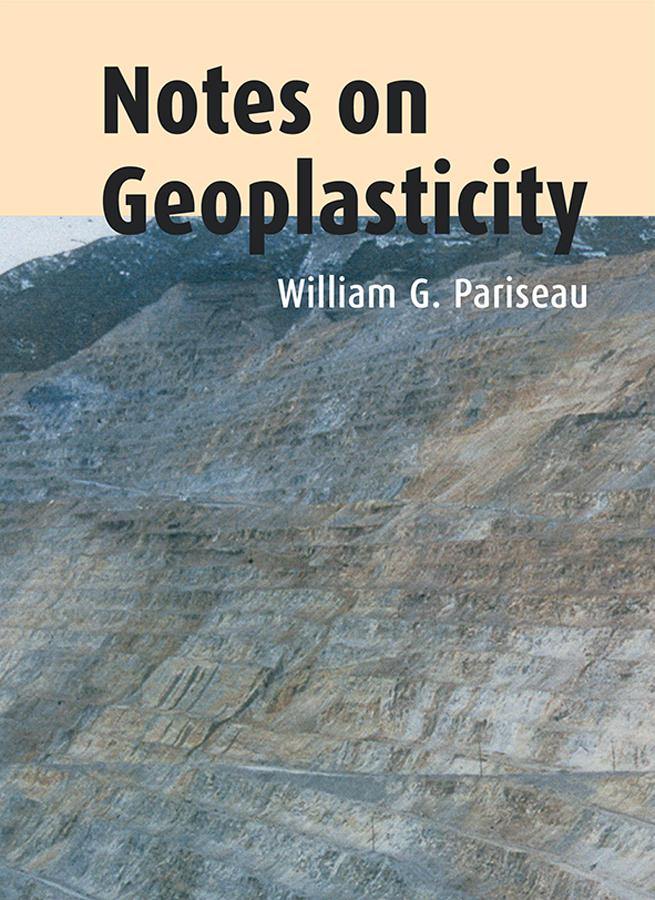
This book is about geoplasticity, solid mechanics of rock, jointed rock and soil beyond the domain of a purely elastic deformation. Plastic deformation is irreversible and begins at the limit to elasticity with any attempt at further loading. Stress at the limit to elasticity is "strength" which is described by a functional relationship amongst stresses, that is, by a yield function or failure criterion. Mohr-Coulomb, Drucker-Prager and Hoek-Brown criteria are well-known examples in geomechanics.
Beyond the elastic limit, but still within the realm of small strain increments, a total strain increment is the sum of an elastic increment and a plastic increment. The elastic increment is computed through an incremental form of Hooke’s law, isotropic or anisotropic as the case may be. Computation of the plastic part is at the core of any plasticity theory and is approached through the concept of a plastic potential. The plastic potential is a function of stresses and perhaps other material parameters such as plastic strain and temperature. Derivatives of the plastic potential with respect to stress lead to the plastic part of the total strain increment. If the yield criterion and plastic potential are the same, then the plastic stress-strain relationships are "associated rules of flow" and follow a "normality" principle. Normality is in reference to a graphical portrayal in principal stress space where the plastic strain increment is perpendicular to the yield surface. If the plastic potential and yield criterion are different, as is often the case in geoplasticity, then the rules of flow are "non-associated". Drucker’s famous stability postulate implies normality at a smooth point on the yield surface, convexity of the yield function and other important features of plasticity theory in geomechanics.
However, there is no point to proceeding to theoretical analyses without physical justification. Hence, the physical foundations for application of plasticity theory to rock, jointed rock and soil are examined in Chapter 2 of this book. A brief review of continuum mechanics principles is given in Chapter 3. Chapter 4 focuses on plane plastic strain and "sliplines". The technical literature is replete with numerous diagrams of sliplines, especially in discussions of foundations on soils, but the relevant mathematics is often lacking and with it genuine understanding. Examples illustrate application of theory to traditional geomechanics problems such as computation of retaining wall forces in soils, foundation bearing capacity of soil and rock, wedge penetration of rock under confining pressure and others. Brief discussions of anisotropy, visco-plasticity and poro-plasticity are presented in Chapters 6, 7 and 8.
This book will be of interest to civil, geological and mining engineers, particularly those involved in reliable design of excavations and foundations beyond elasticity, especially in jointed rock.
Pay easily by card, Klarna, Apple Pay or Google Pay. Not happy? You always have a 14-day money-back guarantee. Read more in our terms. If you have any questions, email us at hello@memmo.org.
Memmo makes studying easier – wherever you are in the world. We bring your course books and smart study tools together in one place: summaries, quizzes, podcasts and flashcards. Plus Ted, your study buddy who answers anything you wonder. Over 50,000 students already study here – built to help you learn faster and stress less.