
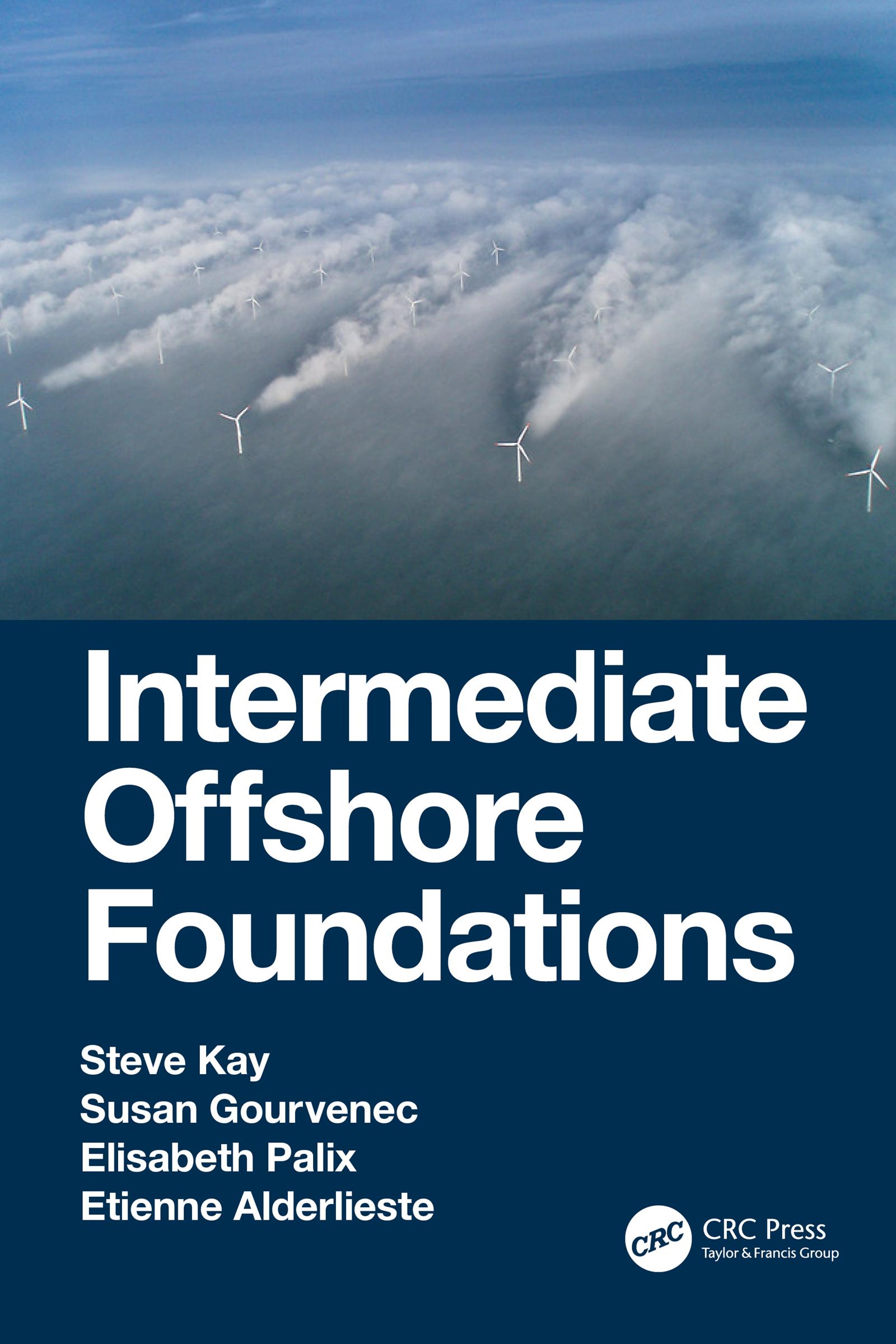
Intermediate foundations are used as anchors for floating platforms and ancillary structures, foundations for steel jackets, and to support seafloor equipment and offshore wind turbines. When installed by suction, they are an economical alternative to piling, and also may be completely removed. They are usually circular in plan and are essentially rigid when laterally loaded. Length to diameter embedment ratios, L/D, generally vary between 0.5 and 10, spanning the gap between shallow and deep foundations, although these are indicative boundaries and the response, rather than the embedment ratio, defines an intermediate foundation.
The first chapters introduce foundation types; compare shallow, intermediate and deep foundation models and design; define unique design issues that make intermediate foundations distinct from shallow and deep foundations, as well as list their hazards that mainly occur during installation. Later chapters cover installation, in-place resistance and in-place response, and miscellaneous design considerations.
There is no general agreement as to which design methods/models are appropriate, so models should only be as accurate as the data. Therefore, several reasonably accurate models are provided together with comprehensive discussion and advice. Example calculations and over 200 references are also included.
This is the first book dedicated to the geotechnical design of intermediate foundations, and it will appeal to professional engineers specialising in the offshore industry.
Pay easily by card, Klarna, Apple Pay or Google Pay. Not happy? You always have a 14-day money-back guarantee. Read more in our terms. If you have any questions, email us at hello@memmo.org.
Memmo makes studying easier – wherever you are in the world. We bring your course books and smart study tools together in one place: summaries, quizzes, podcasts and flashcards. Plus Ted, your study buddy who answers anything you wonder. Over 50,000 students already study here – built to help you learn faster and stress less.