
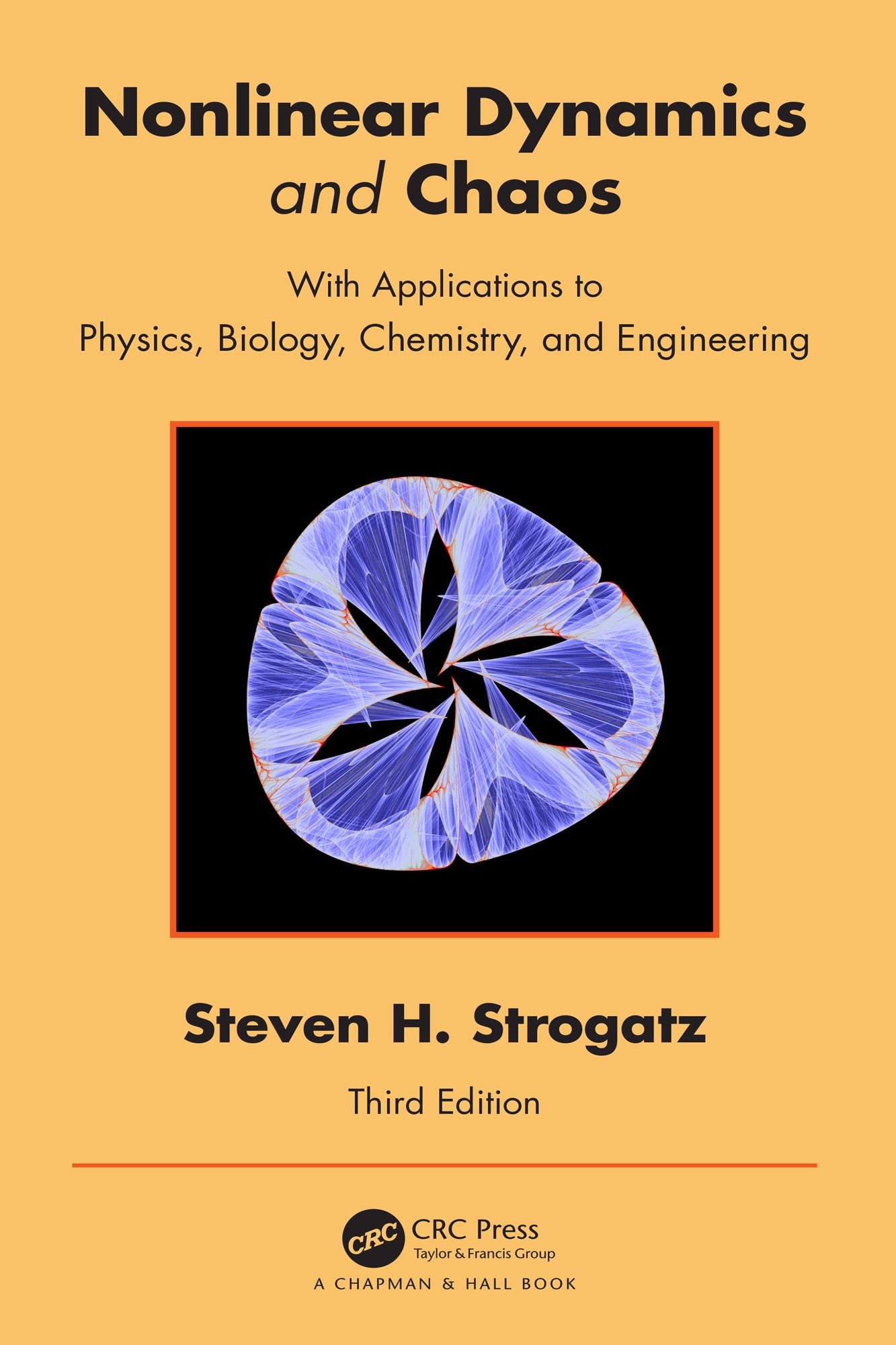
The goal of this third edition of Nonlinear Dynamics and Chaos: With Applications to Physics, Biology, Chemistry, and Engineering is the same as previous editions: to provide a good foundation - and a joyful experience - for anyone who’d like to learn about nonlinear dynamics and chaos from an applied perspective.
The presentation stresses analytical methods, concrete examples, and geometric intuition. The theory is developed systematically, starting with first-order differential equations and their bifurcations, followed by phase plane analysis, limit cycles and their bifurcations, and culminating with the Lorenz equations, chaos, iterated maps, period doubling, renormalization, fractals, and strange attractors.
The prerequisites are comfort with multivariable calculus and linear algebra, as well as a first course in physics. Ideas from probability, complex analysis, and Fourier analysis are invoked, but they're either worked out from scratch or can be safely skipped (or accepted on faith).
Changes to this edition include substantial exercises about conceptual models of climate change, an updated treatment of the SIR model of epidemics, and amendments (based on recent research) about the Selkov model of oscillatory glycolysis. Equations, diagrams, and every word has been reconsidered and often revised. There are also about 50 new references, many of them from the recent literature.
The most notable change is a new chapter. Chapter 13 is about the Kuramoto model.
The Kuramoto model is an icon of nonlinear dynamics. Introduced in 1975 by the Japanese physicist Yoshiki Kuramoto, his elegant model is one of the rare examples of a high-dimensional nonlinear system that can be solved by elementary means.
Students and teachers have embraced the book in the past, its general approach and framework continue to be sound.
Pay easily by card, Klarna, Apple Pay or Google Pay. Not happy? You always have a 14-day money-back guarantee. Read more in our terms. If you have any questions, email us at hello@memmo.org.
Memmo makes studying easier – wherever you are in the world. We bring your course books and smart study tools together in one place: summaries, quizzes, podcasts and flashcards. Plus Ted, your study buddy who answers anything you wonder. Over 50,000 students already study here – built to help you learn faster and stress less.