
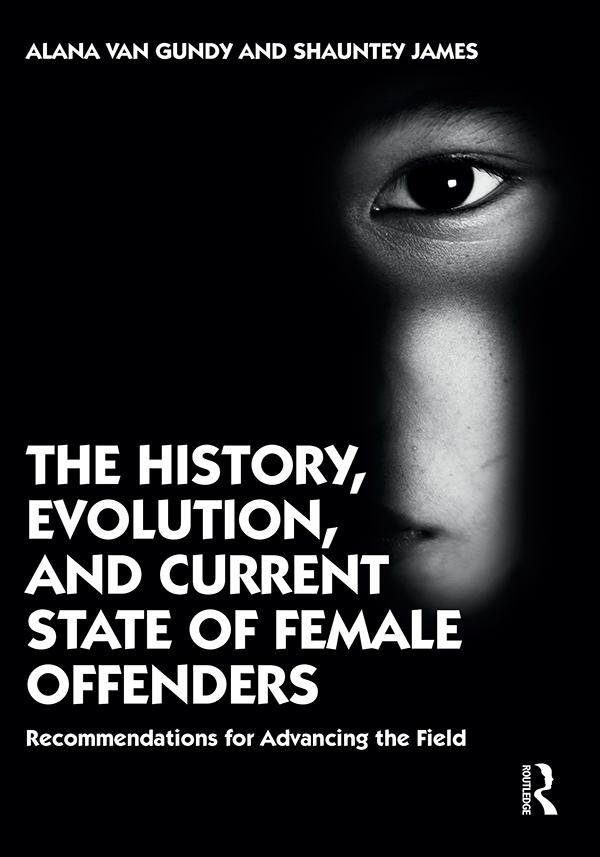
The History, Evolution, and Current State of Female Offenders: Recommendations for Advancing the Field summarizes what the field has learned about females and crime; details the status of legislation and criminological research focused on female criminality; and provides recommendations for advancing the field. Van Gundy and James present the material from a gendered approach with the goal of analyzing the current understanding of the relationship between gender and crime.
Tracing the intellectual history of feminist criminology from its foundations to the present time, the authors follow four primary themes: What do we know about the relationship between gender and crime? What special needs do female offenders have? What works and doesn’t work for female offenders? What can or should we do from here? Reaching back to Carol Smart’s seminal 1976 book, Women, Crime and Criminology: A Feminist Critique (available through Routledge Revivals), the authors note that in some ways, modest progress has been made, but large gaps in research and policy still exist.
This much-needed book provides an overarching view of the history and evolution of the understanding of the relationship between gender and crime, detailed analysis of seminal work and criminological studies, an exploration of incarceration, reentry and programing, and concrete recommendations for future research. These recommendations focus on the importance of creating and utilizing theoretical models that measure the role of gender and identity, inclusion of female-specific variables when examining and responding to criminality, and the necessity of policymakers and legislators to address female criminality from a gendered lens.
The book will appeal to those who are interested in females and criminality, race and ethnicity, policy and evaluation, criminal behavior, criminology, and students in courses in sociology, psychology, women and gender studies, social justice, black world studies, gerontology, and criminology/criminal justice, as well as policymakers and practitioners in the field. It will inspire researchers to ask the kinds of questions that will advance the field of feminist criminology in the future.
Pay easily by card, Klarna, Apple Pay or Google Pay. Not happy? You always have a 14-day money-back guarantee. Read more in our terms. If you have any questions, email us at hello@memmo.org.
Memmo makes studying easier – wherever you are in the world. We bring your course books and smart study tools together in one place: summaries, quizzes, podcasts and flashcards. Plus Ted, your study buddy who answers anything you wonder. Over 50,000 students already study here – built to help you learn faster and stress less.