
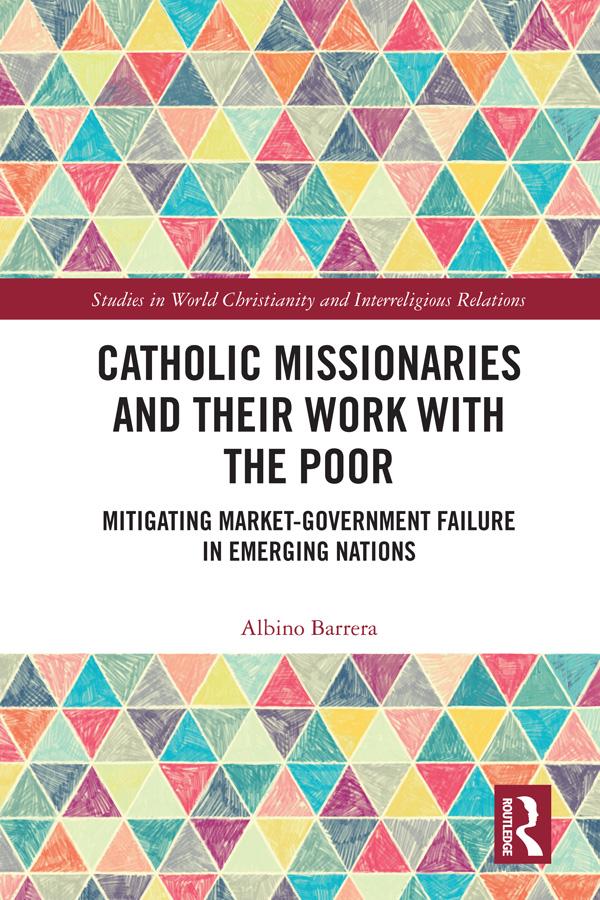
This book explores the vital role of faith-based organizations (FBOs) in compensating for the market’s and government’s inability to provide vital services. Its key theoretical contribution is the notion that poverty is the result of a triadic failure—when markets, government, and civil society become dysfunctional at the same time. Using data on Catholic missionaries’ development work, this study presents the various ways by which FBOs mitigate market and government failures in healthcare, education, and social services, and in the process build and strengthen civil society.
This study has two main objectives. First, it aims to present an overview of missionaries’ development work, evaluating the socioeconomic significance of their faith-based development work. In addition, various comparative advantages and disadvantages have been imputed to FBOs in the religion-development literature, and we assess to what extent missionaries actually exhibit these posited qualities in practice. Second, the groundwork is laid for future religion-development scholars by presenting a theoretical framework and a method for evaluating the role and contributions of FBOs in the larger community.
This is an important investigation of contemporary worldwide Christianity and its relationship with development. As such, it will interest scholars of religious studies and missiology, as well as development economics, public service and the political economy.
Pay easily by card, Klarna, Apple Pay or Google Pay. Not happy? You always have a 14-day money-back guarantee. Read more in our terms. If you have any questions, email us at hello@memmo.org.
Memmo makes studying easier – wherever you are in the world. We bring your course books and smart study tools together in one place: summaries, quizzes, podcasts and flashcards. Plus Ted, your study buddy who answers anything you wonder. Over 50,000 students already study here – built to help you learn faster and stress less.