
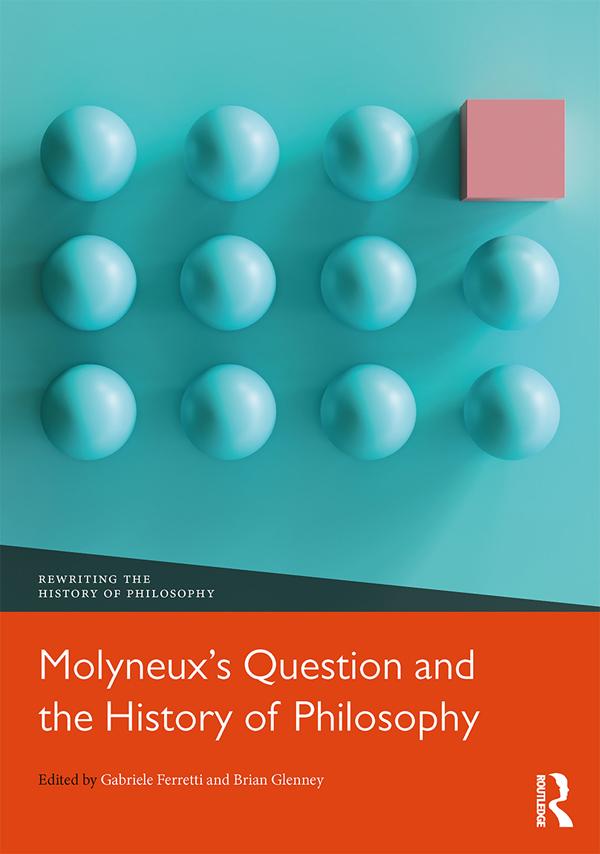
In 1688 the Irish scientist and politician William Molyneux sent a letter to the philosopher John Locke. In it, he asked him a question: could someone who was born blind, and able to distinguish a globe and a cube by touch, be able to immediately distinguish and name these shapes by sight if given the ability to see?
The philosophical puzzle offered in Molyneux’s letter fascinated not only Locke, but major thinkers such as Leibniz, Berkeley, Diderot, Reid, and numerous others including psychologists and cognitive scientists today. Does such a question represent a philosophical puzzle or a problem that can be solved by experimental tests? Can vision be fully restored after blindness? What is the relation between vision and touch? Are the senses linked through learning or bound at birth?
Molyneux’s Question and the History of Philosophy is a major collection of essays that explore the long-standing issues Molyneux’s problem presents to philosophy of mind, perception and the senses. In addition, the volume considers the question from an interdisciplinary angle, examines the pre-history of the question, and aspects of it that have been ignored, such as perspectives from religion and disability.
As such, Molyneux’s Question and the History of Philosophy presents a set of philosophically rich, empirically informed, and scientifically rigorous original investigations into this famous puzzle. It will be of great interest to students and researchers in philosophy, psychology, and the cognitive sciences including neuroscience, neurobiology and ophthalmology, as well as those studying the mind, perception and the senses.
Pay easily by card, Klarna, Apple Pay or Google Pay. Not happy? You always have a 14-day money-back guarantee. Read more in our terms. If you have any questions, email us at hello@memmo.org.
Memmo makes studying easier – wherever you are in the world. We bring your course books and smart study tools together in one place: summaries, quizzes, podcasts and flashcards. Plus Ted, your study buddy who answers anything you wonder. Over 50,000 students already study here – built to help you learn faster and stress less.