
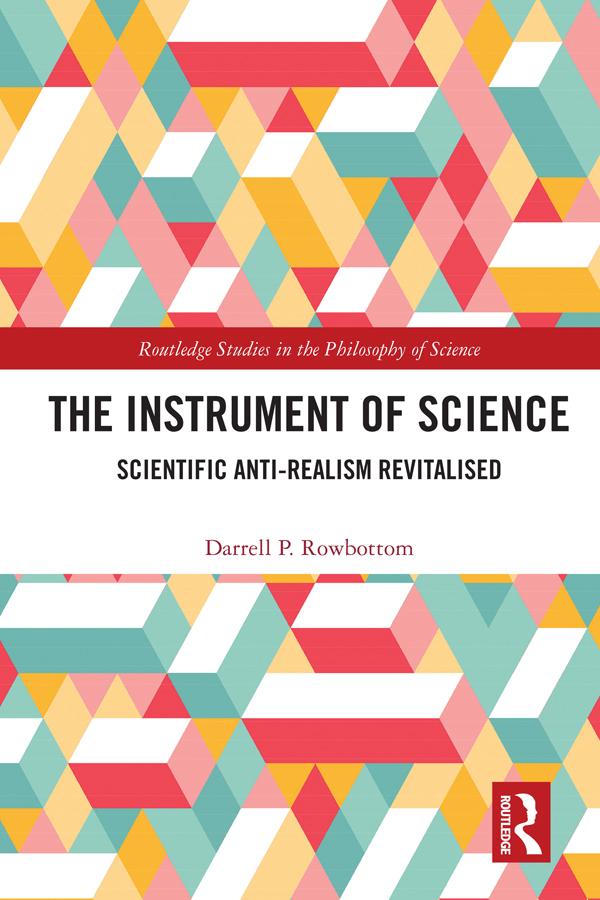
Roughly, instrumentalism is the view that science is primarily, and should primarily be, an instrument for furthering our practical ends. It has fallen out of favour because historically influential variants of the view, such as logical positivism, suffered from serious defects.
In this book, however, Darrell P. Rowbottom develops a new form of instrumentalism, which is more sophisticated and resilient than its predecessors. This position—‘cognitive instrumentalism’—involves three core theses. First, science makes theoretical progress primarily when it furnishes us with more predictive power or understanding concerning observable things. Second, scientific discourse concerning unobservable things should only be taken literally in so far as it involves observable properties or analogies with observable things. Third, scientific claims about unobservable things are probably neither approximately true nor liable to change in such a way as to increase in truthlikeness.
There are examples from science throughout the book, and Rowbottom demonstrates at length how cognitive instrumentalism fits with the development of late nineteenth- and early twentieth-century chemistry and physics, and especially atomic theory. Drawing upon this history, Rowbottom also argues that there is a kind of understanding, empirical understanding, which we can achieve without having true, or even approximately true, representations of unobservable things. In closing the book, he sets forth his view on how the distinction between the observable and unobservable may be drawn, and compares cognitive instrumentalism with key contemporary alternatives such as structural realism, constructive empiricism, and semirealism.
Overall, this book offers a strong defence of instrumentalism that will be of interest to scholars and students working on the debate about realism in philosophy of science.
Pay easily by card, Klarna, Apple Pay or Google Pay. Not happy? You always have a 14-day money-back guarantee. Read more in our terms. If you have any questions, email us at hello@memmo.org.
Memmo makes studying easier – wherever you are in the world. We bring your course books and smart study tools together in one place: summaries, quizzes, podcasts and flashcards. Plus Ted, your study buddy who answers anything you wonder. Over 50,000 students already study here – built to help you learn faster and stress less.