
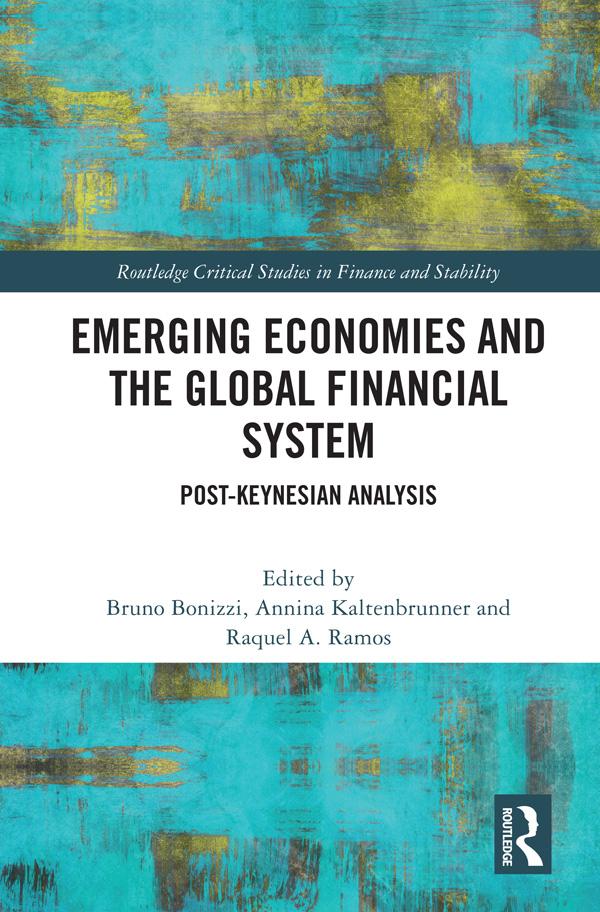
This book provides a comprehensive overview of the financial integration of emerging economies through an in-depth analysis of the international monetary system, how it impacts capital flows and exchange rates, and its implications for policy making.
The financial integration of emerging economies has been a remarkable development of the past two decades. The growth of cross-border transactions and asset ownership, not least through the accumulation of foreign exchange reserves, has put many of these countries in a more prominent, if still peripheral, position within the global financial system. This has not been a smooth process, as integration has been marked by cyclical waves of capital flows, with financial and currency instability often accompanying the acute phases of these cycles. While conventional economic theory traditionally sees financial integration as a positive development, Post-Keynesian economists, working in the tradition of Keynes, Minsky and Kalecki, have long taken a more sceptical viewpoint. By centring the analysis of financial dynamics on concepts as liquidity, uncertainty, balance-sheet structures and institutions, Post-Keynesian theory highlights the intrinsic character of shocks imposed by financial integration upon emerging economies, and their implications for economic growth and distribution. This book demonstrates that these analyses can be fruitfully used to gain a better understanding of financial (in)stability and economic development in emerging economies as they integrate into the global financial system.
This work provides key reading for students and scholars of economics, political economy and finance that are interested in the financial integration of emerging economies, and how the heterodox tradition of Post-Keynesian economics contributes to its analysis.
Pay easily by card, Klarna, Apple Pay or Google Pay. Not happy? You always have a 14-day money-back guarantee. Read more in our terms. If you have any questions, email us at hello@memmo.org.
Memmo makes studying easier – wherever you are in the world. We bring your course books and smart study tools together in one place: summaries, quizzes, podcasts and flashcards. Plus Ted, your study buddy who answers anything you wonder. Over 50,000 students already study here – built to help you learn faster and stress less.