
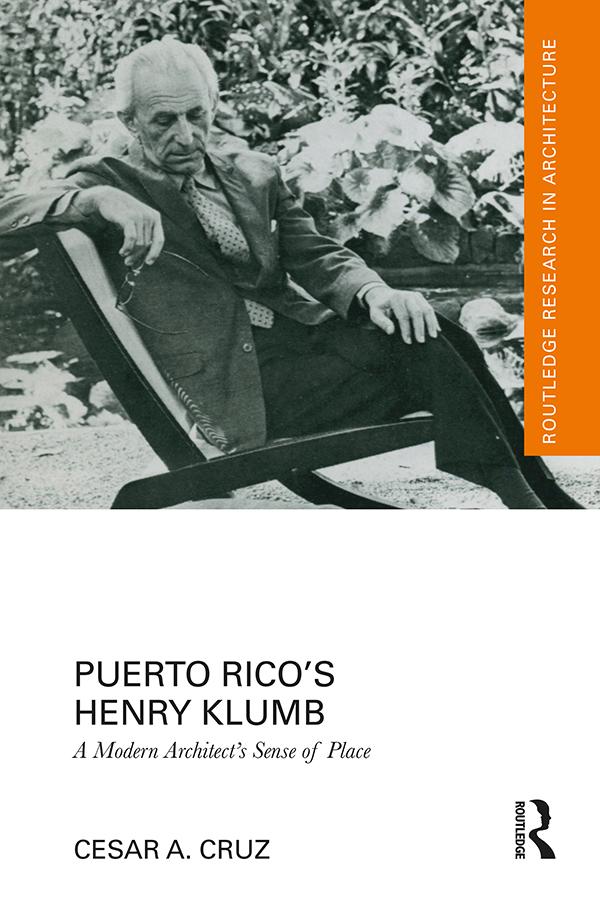
This book follows Henry Klumb’s life in architecture from Cologne, Germany to Puerto Rico. Arriving on the island, Klumb was a one-time German immigrant, a moderately successful designer, and previously a senior draftsman with Frank Lloyd Wright.
Over the next forty years Klumb would emerge as Puerto Rico’s most prolific, locally well-known, and celebrated modern architect. In addition to becoming a leading figure in Latin American modern architecture, Klumb also became one of Frank Lloyd Wright’s most accomplished protégés, and an architect with a highly attuned social and environmental consciousness. Cruz explores his life, works, and legacy through the lens of a sense of place, defined as the beliefs that people adopt, actions undertaken, and feelings developed towards specific locations and spaces. He argues that the architect’s sense of place was a defining quality of his life and work, most evident in the houses he designed and built in Puerto Rico.
Puerto Rico’s Henry Klumb offers a historical narrative, culminating in a series of architectural analyses focusing on four key design strategies employed in Klumb’s work: vernacular architecture, the grid and the landscape, dense urban spaces, and open air rooms. This book is aimed at researchers, academics, and postgraduate students interested in Latin American architecture, modernism, and architectural history.
Pay easily by card, Klarna, Apple Pay or Google Pay. Not happy? You always have a 14-day money-back guarantee. Read more in our terms. If you have any questions, email us at hello@memmo.org.
Memmo makes studying easier – wherever you are in the world. We bring your course books and smart study tools together in one place: summaries, quizzes, podcasts and flashcards. Plus Ted, your study buddy who answers anything you wonder. Over 50,000 students already study here – built to help you learn faster and stress less.