
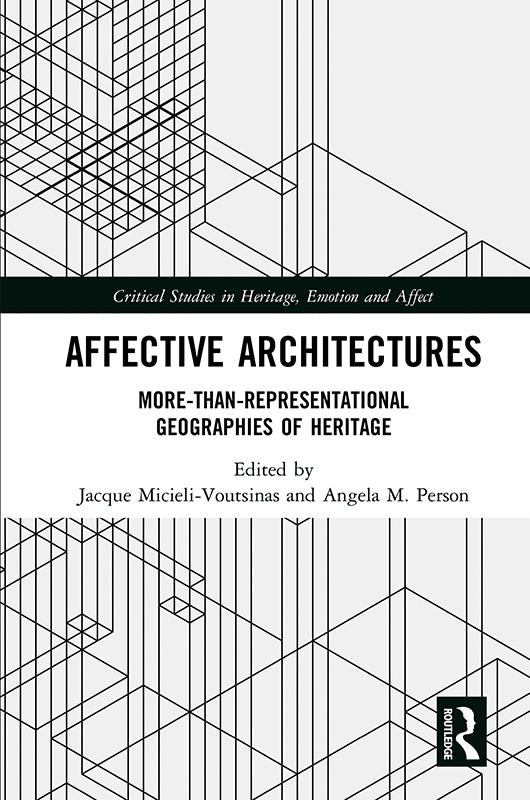
How do places manipulate our emotions? How are spaces affectious in their articulation and design? This book provides theoretical frameworks for exploring affective dimensions of architectural sites based on the notion that heritage, as an embodied experience, is embedded in places and spaces.
Drawing together an interdisciplinary collection of essays spanning geographically diverse architectural sites — including Ford’s Theater, the site of President Lincoln’s assassination; the Estadio Nacional of Santiago, Chile, where 12,000 detainees were held following the ouster of President Salvador Allende; and Unit 731, the site of a biological and chemical warfare research unit of the Imperial Japanese army in Harbin, China, amongst others — this edited collection assembles critical dialogue amongst scholars and practitioners engaging in affective and other more-than-representational approaches to cultural memory, heritage, and identity-making. Broken into three main sections: Affective Politics; Embedded Geographies; and Affective Methodologies, this book draws together multidisciplinary perspectives from the arts, social sciences and humanities to understand the role of architecture in generating embodied experiences at places of memory.
This book offers interdisciplinary perspectives on fundamental questions of memory, identity and space. It will be of interest to students and scholars in the fields of geography, architecture, cultural studies, and museum and heritage studies.
Pay easily by card, Klarna, Apple Pay or Google Pay. Not happy? You always have a 14-day money-back guarantee. Read more in our terms. If you have any questions, email us at hello@memmo.org.
Memmo makes studying easier – wherever you are in the world. We bring your course books and smart study tools together in one place: summaries, quizzes, podcasts and flashcards. Plus Ted, your study buddy who answers anything you wonder. Over 75,000 students already study here – built to help you learn faster and stress less.