
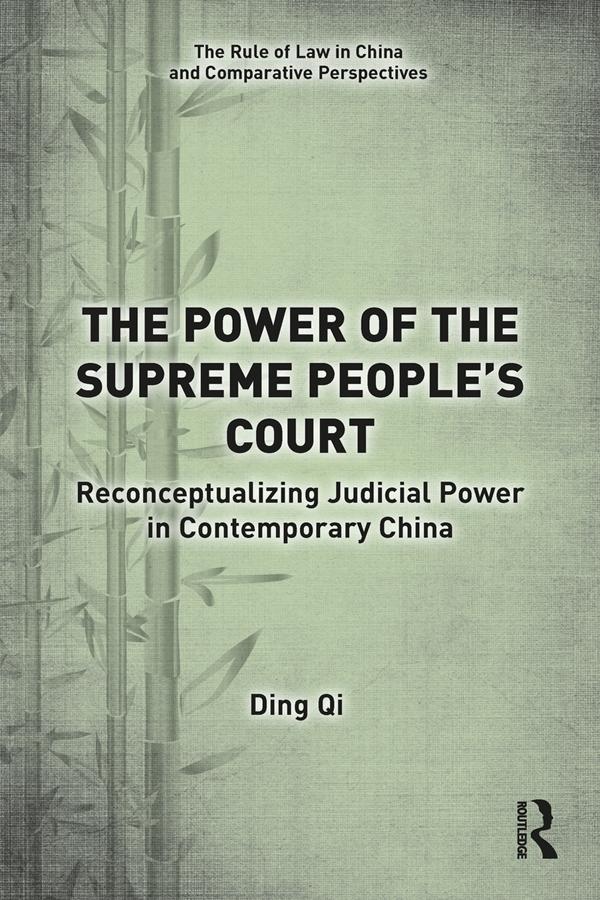
This book explores the recent development of the Supreme People’s Court of China, the world’s largest highest court. Recognizing that its approach to exercising power in an authoritarian context has presented a challenge to the understanding of judicial power in both democratic and non-democratic legal settings, it captures the essence of the Court through its institutional design as well as functional practice. It argues that regardless of the deep-seated political and institutional constraints, the Court has demonstrated a highly pragmatic interest in fulfilling its primary functions and prudently expanding judicial power in the context of reform-era China. This notwithstanding, it also discusses how the Court’s incompetence and reluctance to challenge the bureaucratism and politicization suggests that the call for an impartial and authoritative judicial power will continue to be jeopardized while the Court operates in the shadow of Party authority and lacks meaningful checks and balances. Drawing on the experience of the Court, this book reflects on some deep-rooted misunderstandings of legal development in China, providing a source of inspiration for reconceptualizing the internal logic of a distinct category of judicial power.
Pay easily by card, Klarna, Apple Pay or Google Pay. Not happy? You always have a 14-day money-back guarantee. Read more in our terms. If you have any questions, email us at hello@memmo.org.
Memmo makes studying easier – wherever you are in the world. We bring your course books and smart study tools together in one place: summaries, quizzes, podcasts and flashcards. Plus Ted, your study buddy who answers anything you wonder. Over 50,000 students already study here – built to help you learn faster and stress less.