
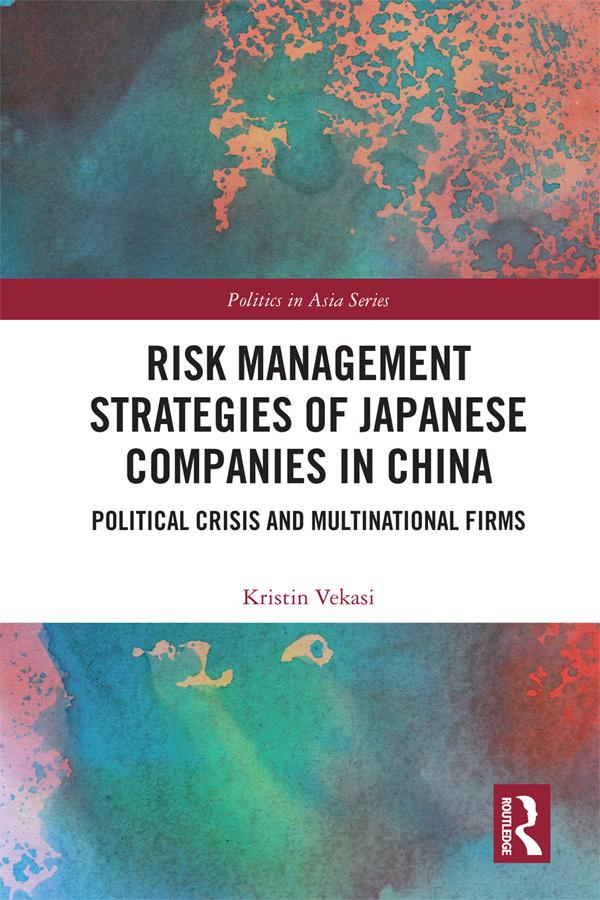
In the context of political tensions and rising economic interdependence between Japan and China, this book studies how Japanese multinational companies try to minimize damages and manage their own fear and uncertainty to sustain their business interests.
Using a qualitative approach, including over 150 interviews with Japanese and Chinese business and industry leaders, combined with statistical analysis of unique firm-level data, this book brings a ‘firm-level view’ to this crucial case of political conflict amid economic interdependence. It argues that there is wide variation in the degree of material damages Japanese multinationals sustain in the aftermath of political disputes, and how threatening they perceive the risks of political conflict to be. This book then goes on to evaluate the different responses to risk, from promoting Japan's culture through privately funded tactics and building common cause with the government, to diversifying a portion of assets abroad and even leaving China entirely.
Presenting a new angle on economic globalization in the Asia Pacific region, Risk Management Strategies of Japanese Companies in China will be useful to students and scholars of Asian politics, business, and economics as well as international political economy.
Pay easily by card, Klarna, Apple Pay or Google Pay. Not happy? You always have a 14-day money-back guarantee. Read more in our terms. If you have any questions, email us at hello@memmo.org.
Memmo makes studying easier – wherever you are in the world. We bring your course books and smart study tools together in one place: summaries, quizzes, podcasts and flashcards. Plus Ted, your study buddy who answers anything you wonder. Over 50,000 students already study here – built to help you learn faster and stress less.